Does Creatine Timing Actually Matter? What the Research Says vs What Gets Marketed
Quick Answer: Barely. Creatine works by saturating muscle over days to weeks, not acutely like a pre-workout — so any single dose’s timing matters far less than taking it daily. Direct pre- versus post-workout comparisons show small, inconsistent differences. This is general information, not medical advice.
There’s a genuinely strange amount of internet confidence about whether creatine goes in the shaker before or after training.
The mechanism doesn’t really support that level of precision. Creatine is a bucket you’re filling, not a switch you’re flipping.

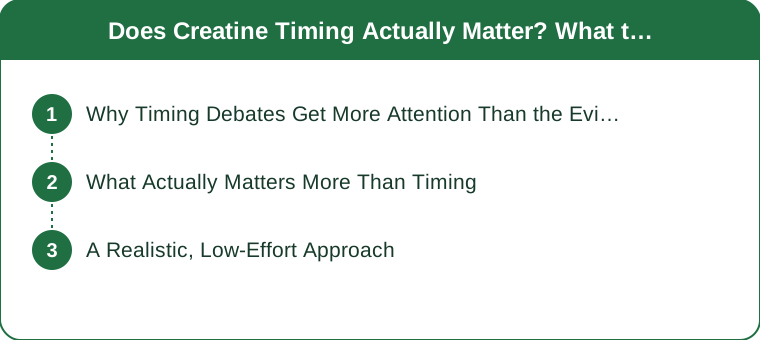
Why does timing get so much attention?
The mechanism is saturation-based. Creatine builds up in muscle over days to weeks of consistent use. It doesn’t act acutely on the session in front of you, which makes any single dose’s timing a minor variable inside total daily intake.
The direct research is underwhelming. Studies specifically comparing pre- and post-workout timing generally show small or inconsistent differences — nothing resembling the confidence of the advice around it.
Simple products don’t sell premium. There’s a persistent industry incentive to make an effective, cheap, simple supplement feel like it requires expert-level precision. Complexity supports pricing and branded timing products.
Advice replicates rather than checks. Popular timing guidance is largely repeated content rather than independently verified against the underlying research, so a thin claim circulates as if it were settled.
The gap isn’t between right and wrong answers. It’s between how strong the evidence is and how confidently it gets stated.
What matters more than timing?
- Daily consistency over weeks. The single most evidence-supported factor, and it dwarfs every timing nuance inside it.
- An adequate total daily dose. Hitting the amount matters considerably more than splitting hairs over morning versus evening.
- Hydration. More practically relevant to manage than timing precision for most people — our hydration guide covers what actually changes.
- Product quality and accurate dosing. A correctly dosed monohydrate matters more for getting the intended effect than any timing window.
- A long-horizon view. The benefit builds over weeks to months. Framing it as “optimal timing around today’s workout” somewhat misunderstands the supplement.

What Nobody Tells You
A missed day is nearly irrelevant. Because saturation is slow, one skipped dose barely moves the needle. People stress about timing to the minute while treating a missed week as equivalent — it’s exactly backwards.
Monohydrate is still the answer. The premium forms marketed as better-absorbing have not displaced plain creatine monohydrate as the best-studied, cheapest, most reliable option. Timing debates and fancy-form debates come from the same marketing well.
The loading phase is optional. Loading reaches saturation faster; a standard daily dose gets to the same place in three or four weeks. Neither is wrong, and one is easier.
Rest days count. Since you’re maintaining saturation rather than fuelling a session, taking it on non-training days is the point — not an optional extra. This is the most common genuine mistake.
Scale weight will move early. A few pounds of intracellular water weight in the first weeks is expected and isn’t fat gain. Knowing that in advance prevents a lot of unnecessary quitting.
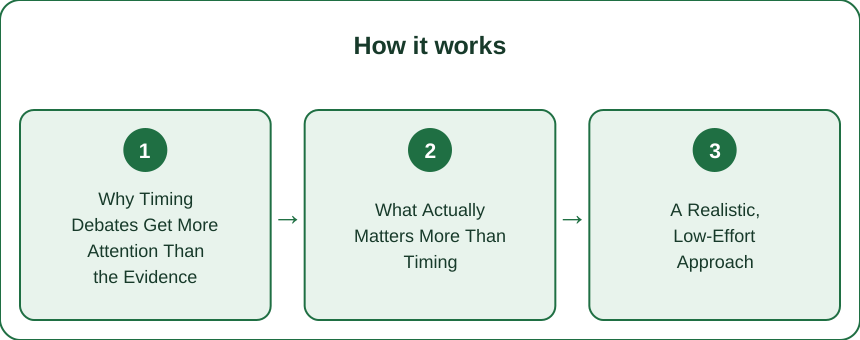
What’s the realistic, low-effort approach?
Pick the time you’ll actually keep. Consistency is the real lever, so choose whatever slot you’ll maintain rather than chasing a marginal theoretical advantage.
Attach it to an existing habit. Morning coffee, a post-workout shake, brushing your teeth. Habit-stacking supports the consistency that genuinely matters.
Stop tracking any single day’s timing. The evidence doesn’t support that level of precision, and the mental overhead is the real cost.
Redirect the attention to hydration and dose. Those have stronger evidence behind them and are more actionable than the pre-versus-post question.
Expect the same multi-week timeline. No reasonable timing choice speeds up or slows down saturation meaningfully. Give it three to four weeks before judging anything.
Talk to a doctor or pharmacist before starting creatine if you have kidney or liver conditions, are pregnant or breastfeeding, or take prescription medication — particularly anything affecting kidney function. Creatine is among the better-studied supplements available, and “well-studied” isn’t the same as “right for everyone.” One practical note: creatine can raise measured creatinine on a blood test without indicating a kidney problem, so tell your doctor you’re taking it before any lab work. This is general information, not medical advice.
FAQ
Should I take creatine on rest days?
Yes. You’re maintaining muscle saturation, not fuelling individual sessions, so daily intake including rest days is the whole approach. This is arguably the timing question that actually matters.
Does it matter what I mix creatine with?
Not much. It dissolves better in warm liquid and there’s some evidence that taking it with carbohydrate or protein aids uptake slightly, but the effect is small relative to just taking it consistently. What you mix it into is mostly a palatability question.
How long until creatine actually works?
Roughly three to four weeks at a standard daily dose, or about a week with a loading protocol. Either way you’re waiting for saturation, and timing your dose relative to training doesn’t shorten that.
TL;DR:
- Creatine saturates muscle over weeks; it doesn’t act acutely on a single session.
- Direct pre- versus post-workout research shows small, inconsistent differences.
- Daily consistency, adequate total dose, hydration, and product quality all matter more than timing.
- Rest-day dosing is the timing question that genuinely matters — take it every day.
- Pick a time you’ll keep, attach it to an existing habit, stop tracking the clock.
- Expect three to four weeks to saturation. Talk to a doctor first if you have kidney or liver conditions, are pregnant or breastfeeding, or take prescription medication. This is general information, not medical advice.
Keep Reading
This article is for general informational purposes only and is not medical advice. Always consult a qualified health professional for guidance specific to you.