Creatine and Your Blood Test: What Creatinine Actually Means
Quick Answer: Creatine supplementation raises serum creatinine, and this is expected rather than alarming. Creatinine is the waste product of creatine breakdown, so taking more creatine means more creatinine in circulation - roughly a 0.1 to 0.3 mg/dL rise is typical. Because eGFR is calculated from creatinine, your estimated kidney function will appear to drop even though filtration is unchanged. The critical move is to tell your doctor you supplement, and if there is any doubt, ask for cystatin C - a kidney marker creatine does not affect. Actual kidney injury shows up alongside other abnormalities; creatine alone does not produce them.
The result lands in the patient portal at some unhelpful hour. Creatinine flagged high. Estimated kidney function down. No context, no phone call, just a red marker and a weekend to think about it.
And if you take five grams of creatine most mornings, the connection arrives immediately and feels obvious in the worst way.
The connection is real. The conclusion is wrong, and the reason why is genuinely worth understanding - because the same misunderstanding causes people to stop a supplement they did not need to stop, and occasionally causes a doctor to order tests nobody needed.

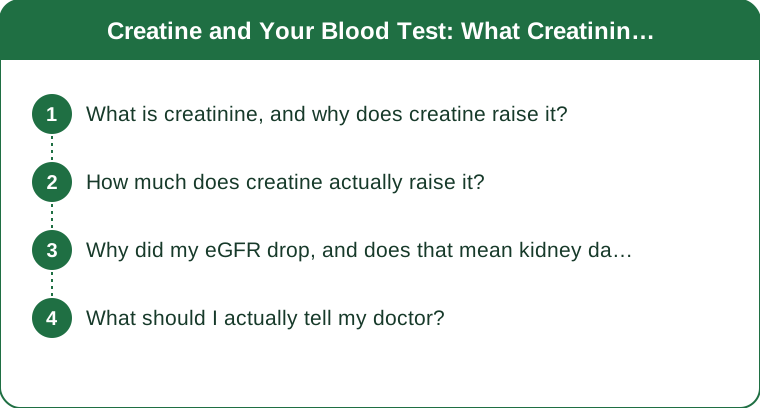
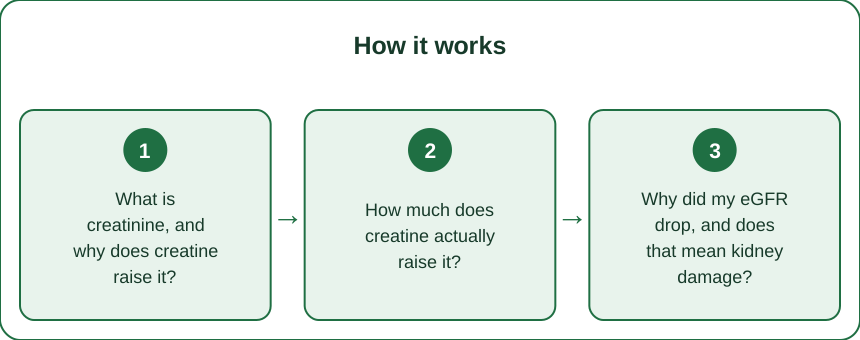
What is creatinine, and why does creatine raise it?
Creatinine is what creatine turns into when it has finished its job.
That is the whole mechanism, and once you see it the lab result stops being mysterious. Creatine sits in your muscles as creatine and phosphocreatine, and roughly 1 to 2 percent of that pool spontaneously converts to creatinine every day - not through any regulated process, just chemical breakdown. Creatinine is metabolically useless, so your kidneys filter it out and it leaves in urine.
That makes creatinine a byproduct that scales with how much creatine you have. Load the muscle pool with supplementation and more creatine is breaking down each day, so more creatinine appears in the blood. Your kidneys are clearing it exactly as well as they were before. There is simply more arriving.
This is why creatinine has always been an imperfect kidney marker. It is influenced by anything that changes muscle creatine turnover:
- Muscle mass - more muscle means higher baseline creatinine, which is why the same number means different things in a 95 kg lifter and a 50 kg sedentary adult
- Creatine supplementation - the direct effect we are discussing
- A large meat meal - cooked meat contains creatine and creatinine, and a steak dinner can nudge a next-morning result
- Intense exercise in the preceding days - increased muscle turnover
- Hydration status - concentrates or dilutes the sample
None of those are kidney problems. All of them move the number.
How much does creatine actually raise it?
Typically 0.1 to 0.3 mg/dL, which is small in absolute terms and large relative to a normal range.
That combination is exactly why it causes alarm. Normal serum creatinine sits roughly at 0.6 to 1.1 mg/dL for women and 0.7 to 1.3 for men, so a 0.2 rise can push a perfectly normal 1.0 to a flagged 1.2 without anything having changed physiologically.
The size of the shift depends on a few things:
Loading versus maintenance. A 20 g/day loading protocol produces the largest rise, because you are saturating the pool fast. A steady 3 to 5 g/day maintenance dose produces a smaller, stable elevation.
How long you have been taking it. The rise appears within days of starting and then holds at a new steady state. It does not keep climbing - which is itself reassuring, and is a useful thing to point out. Progressive kidney disease produces a rising trend. Creatine produces a step and then a plateau.
Your muscle mass. More muscle carrying more creatine means a bigger absolute effect.
And it is fully reversible. Stop supplementing and creatinine returns to baseline over roughly two to four weeks as the muscle pool washes out.

Why did my eGFR drop, and does that mean kidney damage?
Your eGFR dropped because it is calculated from creatinine. Nothing measured your kidneys directly.
This is the part that causes the most unnecessary fear, and it deserves stating plainly. eGFR is not a measurement. It is an estimate, produced by putting your creatinine, age, and sex into an equation. The e stands for estimated.
Those equations assume creatinine comes from ordinary muscle turnover. Creatine supplementation breaks the assumption. So a supplement-driven creatinine rise gets translated by the formula into an apparent drop in filtration rate that is not happening. The kidneys are unchanged. The input to the equation changed.
This is not unique to creatine. The same limitation applies to bodybuilders, to people on high-meat diets, and in the opposite direction to people with very low muscle mass, whose eGFR is often flattered - which is a well-known problem in assessing kidney function in frail older adults.
So what would actual kidney trouble look like? Not creatinine alone. Real kidney impairment usually shows up as a cluster:
- Protein or albumin in the urine - often the earliest genuine sign
- Blood urea nitrogen (BUN) rising alongside creatinine, changing the BUN-to-creatinine ratio
- Abnormal electrolytes - potassium and phosphate in particular
- A rising trend over repeated tests, rather than a stable elevated plateau
- Symptoms - swelling, urine output changes, persistent fatigue
An isolated creatinine elevation in someone who supplements creatine, with a clean urinalysis and normal everything else, is the textbook picture of a lab artefact.
What should I actually tell my doctor?
Be specific, and lead with it rather than waiting to be asked. Most clinicians know creatine raises creatinine, but they cannot account for a supplement they do not know you take.
Say all of this:
- That you take creatine, the dose, and how long you have been on it
- Whether you are loading or on maintenance - it changes the expected magnitude
- When you last took it relative to the blood draw
- Your training - heavy resistance training in the days before a test independently raises creatinine
- Whether you had a large meat meal the day before
Then ask for the tests that settle it. There are three good options:
Cystatin C. This is the strong one. It is a protein filtered by the kidneys that is not affected by muscle mass or creatine supplementation, and an eGFR calculated from cystatin C sidesteps the whole problem. If your cystatin C-based eGFR is normal and your creatinine-based one is not, you have your answer.
Urine albumin-to-creatinine ratio (uACR). Cheap, widely available, and one of the most useful early indicators of genuine kidney injury. Creatine does not cause albuminuria.
A repeat test after a washout. If you and your doctor want certainty and there is no urgency, stop creatine for two to four weeks and retest. If it normalises, the question is closed.
Should I stop taking creatine before a blood test?
If you know a routine test is coming and you want a clean baseline, pausing for two to four weeks gives you an uncomplicated result. But do not do this quietly and then not mention the supplement - a normal creatinine from someone who stopped a week ago, with no explanation, is more confusing to a clinician than a slightly high one with context.
Does this mean creatine is hard on the kidneys?
In people with healthy kidneys, the research on creatine at standard doses is reassuring and has been for a long time, including studies running years rather than weeks. What has not been well established is safety in people who already have kidney disease - and that is a genuinely different question. If you have known kidney impairment, this is a decision to make with your nephrologist, not from an article.
Can creatine cause a false diagnosis?
It can contribute to one, which is precisely why disclosure matters. An unexplained elevated creatinine with a reduced eGFR can trigger a chronic kidney disease workup, referrals and repeat testing that a single sentence about your supplement would have prevented.
This is general information, not medical advice. Interpreting your own lab results is genuinely not something to do alone - bring these questions to the clinician who ordered the test.
TL;DR:
- Creatinine is creatine’s breakdown product. More creatine in the muscle means more creatinine in the blood. This is expected, not a warning sign.
- Typical rise: 0.1 to 0.3 mg/dL, appearing within days of starting and then holding flat rather than climbing.
- eGFR is calculated from creatinine, so it will appear to drop while actual filtration is unchanged.
- Tell your doctor you supplement, and ask for cystatin C or a urine albumin-to-creatinine ratio if there is any doubt.
- Real kidney disease comes as a cluster - protein in urine, abnormal electrolytes, a rising trend. Not one isolated marker.
The marker moved because you changed the thing the marker is made of. Say that out loud in the appointment and the whole conversation gets shorter.
Keep Reading
This article is for general informational purposes only and is not medical advice. Always consult a qualified health professional for guidance specific to you.