Does Creatine Timing Actually Matter? What the Research Really Says
Quick Answer: Creatine timing has a much smaller effect than consistency does — daily use, regardless of exact time, is what builds and maintains muscle creatine stores. Some evidence slightly favors taking it near a workout (before or after) over a random time of day, but the difference is minor compared to simply taking it every day.
You’ve read that creatine has to be taken at a precise time to work, and now you’re overthinking a supplement that’s actually one of the most forgiving in terms of timing.

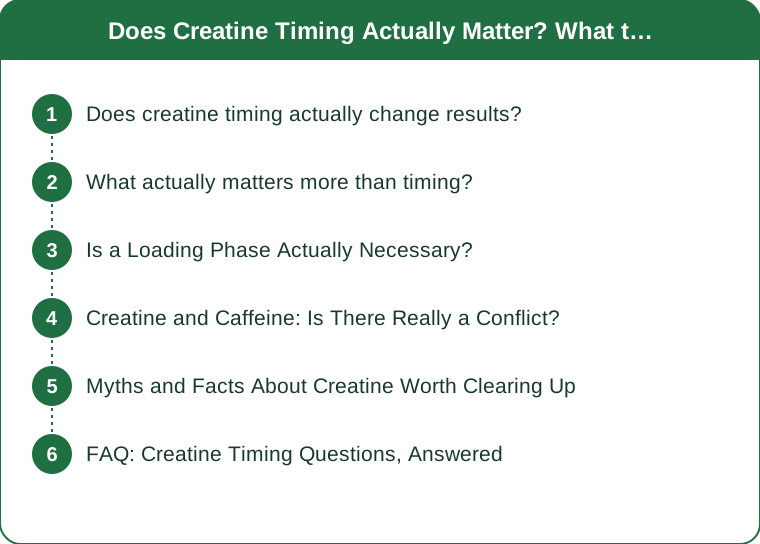
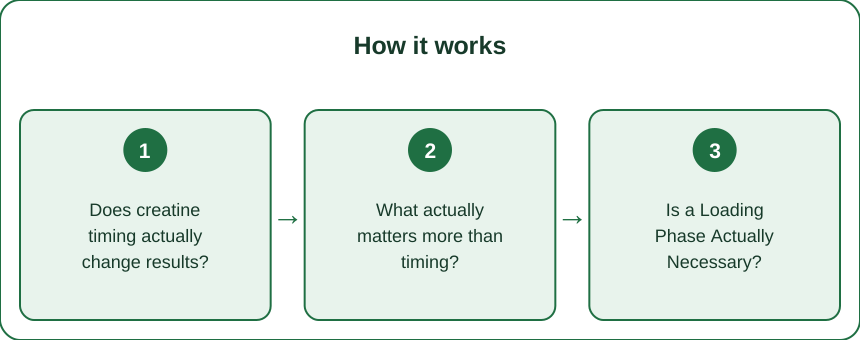
Does creatine timing actually change results?
The evidence is mixed and the effect size is small — a few studies show a slight edge to taking creatine close to a workout (before or after) versus a random time of day, but the difference between the best and worst timing choices is far smaller than the difference between taking it daily versus skipping days.
What actually matters more than timing?
Daily consistency. Creatine works by gradually saturating your muscle stores over roughly 2-4 weeks of daily use (faster with a loading phase). Missing days repeatedly matters far more to your results than whether you take it at 7am or 7pm.
Is a Loading Phase Actually Necessary?
A loading phase (about 20g/day split into doses for 5-7 days) saturates muscle stores faster, but a steady 3-5g daily dose without loading reaches the same saturation point in about 3-4 weeks. Loading isn’t necessary — it just gets you there sooner, which matters more if you’re on a tight timeline before a specific event.

Creatine and Caffeine: Is There Really a Conflict?
Some early research suggested caffeine might blunt creatine’s effects, but more recent and larger studies haven’t strongly supported a meaningful real-world conflict for most people at normal intake levels. If you’re a heavy caffeine user genuinely worried about this, separating them by a couple hours is a reasonable low-cost precaution, not a strict requirement.
Myths and Facts About Creatine Worth Clearing Up
Myth: Creatine causes kidney damage in healthy people. Fact: In people with normal kidney function, research hasn’t shown meaningful kidney harm at standard doses — this myth largely originated from confusing creatine supplementation with elevated creatinine, a lab marker, not actual damage.
Myth: Creatine causes major water retention that shows on the scale. Fact: Mild water retention (a few pounds) inside muscle cells is normal and expected early on — this is not the same as bloating or fat gain, and it stabilizes after the initial adjustment period.
FAQ: Creatine Timing Questions, Answered
Is it bad to take creatine on rest days?
No — taking it daily, including rest days, is exactly how you maintain saturated muscle stores; skipping rest-day doses slows progress slightly over time.
Does creatine affect hydration needs?
Slightly — drinking adequate water alongside daily creatine use is a reasonable habit, though dramatic extra hydration isn’t required for most healthy adults.
Is creatine safe and effective for women specifically?
Yes — research supports similar benefits for women as for men, though women are sometimes underdosed relative to body weight; check dosing against your own weight rather than a generic serving size. This is general information, not medical advice.
TL;DR:
- Timing has a small effect at best — daily consistency matters far more
- A loading phase speeds saturation but isn’t required; daily 3-5g gets there in 3-4 weeks
- The caffeine-blocks-creatine concern isn’t strongly supported by recent research
- Mild early water retention is normal and not the same as bloating or fat gain
Stop optimizing the clock — the calendar (taking it every single day) is what actually determines your results.
Keep Reading
This article is for general informational purposes only and is not medical advice. Always consult a qualified health professional for guidance specific to you.