Creatine While Traveling: The Questions People Actually Ask
Quick Answer: Creatine travels fine. Powder in carry-on is permitted in most jurisdictions but is more likely to be swabbed or hand-checked if it is a large unlabelled quantity, so keep it in a labelled container or use capsules. A week or two off will not undo your stores meaningfully - muscle creatine declines slowly over several weeks, and you can simply resume your usual daily dose on return without reloading.
Most creatine questions get answered somewhere. Travel questions do not, and they are the ones that actually come up in August when half of everyone is somewhere else. Here they are, in the order people ask them.

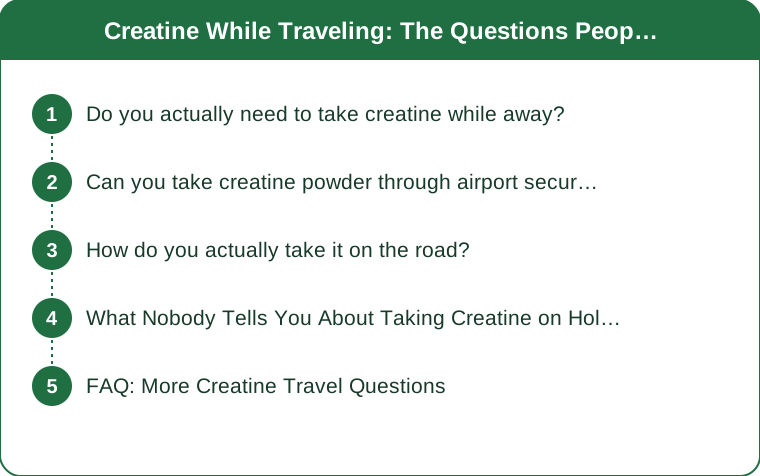
Do you actually need to take creatine while away?
Not urgently, and the reason is how slowly muscle creatine stores decline.
Once saturated through consistent daily use, muscle creatine content is elevated well above baseline. When supplementation stops, that elevation washes out gradually rather than dropping off a cliff - research on cessation indicates a return towards baseline over a period of roughly four to six weeks, not days.
So for a trip of a week or two, the practical answer is that skipping does very little. You may notice slightly less fullness in the muscle towards the end of a longer trip, largely because creatine draws water into muscle cells and that effect fades. Strength changes over that timeframe are minimal and are more likely explained by different training, different sleep, and different food.
Where it is worth continuing:
- Trips longer than about three weeks, where the decline becomes more meaningful.
- Training camps or active holidays where you are actually training hard.
- Anyone taking creatine primarily for cognitive reasons rather than strength, where consistency matters differently and the research is still developing.
Where it genuinely does not matter: a five-day trip where you are mostly walking around and eating well. Take it if it is easy, skip it if packing it is annoying, and do not construct a problem out of it.
And the resumption question: you do not need to reload on return. Go straight back to your usual daily maintenance dose. Stores rebuild over a few weeks, which is exactly what a maintenance dose is for. This is general information, not medical advice.
Can you take creatine powder through airport security?
In general yes, with caveats worth knowing before you are standing at the scanner.
Powders are permitted in carry-on baggage in most jurisdictions, but quantity triggers scrutiny. Security agencies in several countries advise that powder-like substances above roughly 350ml or 12 ounces in carry-on may require additional screening, and that placing larger quantities in checked baggage avoids delay. A full tub of creatine is comfortably over that threshold.
What reduces friction:
- Keep it in the original labelled container if the quantity is modest. A branded tub with an ingredient panel raises fewer questions than a clear bag of white powder.
- Decant into a small labelled container for shorter trips - a week’s worth is around 35 grams, which is a very small container.
- Use capsules or single-serve sachets. These are the lowest-hassle option by a wide margin and are worth buying specifically for travel even if you use powder at home.
- Put bulk quantities in checked baggage where screening is different and quantity limits do not apply the same way.
Expect the possibility of a swab test. Explosive trace detection swabbing of powders and containers is routine and is not an accusation of anything. It takes under a minute.
International travel adds one more consideration: supplement regulations differ by country, and while creatine is legal and widely sold in most places, a few jurisdictions have restrictions on importing supplements in quantity. For personal amounts this is rarely an issue, but it is worth a search if you are travelling somewhere with strict customs rules.

How do you actually take it on the road?
The logistics are simple once you stop trying to replicate your home routine exactly.
Dosing. Standard maintenance is 3 to 5 grams daily. Timing genuinely does not matter much - the evidence for pre- versus post-workout timing is weak, and total daily consistency matters far more. So take it whenever it is convenient in the day you are actually having.
Mixing. Creatine monohydrate dissolves better in warm liquid than cold. On the road that means it will be gritty in a cold hotel water bottle. Options that work:
- Stir into coffee or tea - the warmth dissolves it and the taste is negligible.
- Mix into yoghurt or a smoothie at breakfast.
- Take capsules, which sidesteps the entire mixing problem.
- Stir into a small amount of warm water, drink it, then chase with cold water.
Hydration. Creatine increases intracellular water, so adequate fluid intake matters, and travel days are already dehydrating - dry cabin air, more caffeine, more alcohol, less routine. This is the one genuine interaction worth attention on a trip, particularly somewhere hot. It is not that creatine causes dehydration, but that being under-hydrated while travelling is common and creatine gives you one more reason to fix it.
Heat and storage. Creatine monohydrate is stable at room temperature but degrades faster in solution, particularly warm solution. Do not pre-mix a bottle in the morning and leave it in a hot car all day. Mix and drink.
What Nobody Tells You About Taking Creatine on Holiday
Water weight fluctuations will confuse you. Creatine draws water into muscle. Travel adds salt, alcohol, disrupted sleep, and long periods of sitting - all of which shift fluid too. The scale on your return will tell you almost nothing useful for a good week. Do not weigh yourself the day you get home, and do not attribute the number to creatine specifically.
Stopping and restarting is not a loading problem. There is a persistent belief that every restart requires a five-day loading phase at 20 grams. It does not. Loading only accelerates saturation; a maintenance dose reaches the same place, just over a few weeks. After a fortnight away you were never far from saturated anyway.
Capsules are less efficient than they look. Most creatine capsules contain around 750mg to 1g, so a 5-gram dose is five to seven capsules. Convenient for travel, tedious and expensive as a daily habit.
The gritty hotel-room shake puts people off entirely. More travel creatine plans die from unpleasant texture than from any real obstacle. Solve the texture before the trip, not during it.
And if you are travelling to compete, check the rules of your governing body. Creatine is not a banned substance in any major anti-doping code, but contamination of supplements with banned compounds is a genuine and documented risk - which is an argument for third-party tested products rather than whatever is available at your destination.
FAQ: More Creatine Travel Questions
Will I lose my gains if I stop creatine for two weeks?
No. Muscle creatine declines gradually over roughly four to six weeks after stopping, so a two-week break leaves you close to where you were. You may notice slightly less muscle fullness, which is a water effect and reverses quickly.
Do I need to load creatine again after a break?
No. Resume your normal 3 to 5 grams daily. Loading only speeds up saturation; it is not required after a short break, and after two weeks off you are still well above baseline.
Can I put creatine in checked luggage?
Yes, and for larger quantities that is generally the smoother option since carry-on powder above roughly 350ml often triggers additional screening. Keep it sealed and ideally in a labelled container.
Does creatine make dehydration worse in hot weather?
The evidence does not support creatine causing dehydration or heat illness, and some studies suggest no increased risk. That said, it does increase intracellular water, so adequate fluid intake matters - which is sensible advice for anyone in late-summer heat regardless of supplements. This is general information, not medical advice.
TL;DR:
- A one or two week break barely matters - stores decline over four to six weeks, not days.
- Powder is allowed in carry-on but large quantities invite extra screening; capsules or a small labelled container are easier.
- No reloading needed on return; go straight back to 3 to 5 grams daily.
- Mix into something warm, not a cold hotel water bottle, or the texture will end the habit.
- Hydration matters more on travel days than any timing question.
The honest summary is that creatine is one of the least demanding things in your bag. Pack it if it is easy, and stop treating a week off as a setback.
Keep Reading
This article is for general informational purposes only and is not medical advice. Always consult a qualified health professional for guidance specific to you.