What Actually Happens to Your Body When You Stop Taking Creatine?
Quick Answer: Stopping creatine doesn’t cause a ‘crash’ or withdrawal effect in the way that phrase implies — muscle creatine stores gradually decline back toward your body’s natural baseline over roughly 4-6 weeks, and any strength or performance changes reflect this gradual return to baseline levels, not a sudden negative effect from stopping.
You’ve seen creatine described as something you ‘crash’ from if you stop, similar to language used around stimulants. The actual physiological process is far more gradual and far less dramatic than that framing suggests.

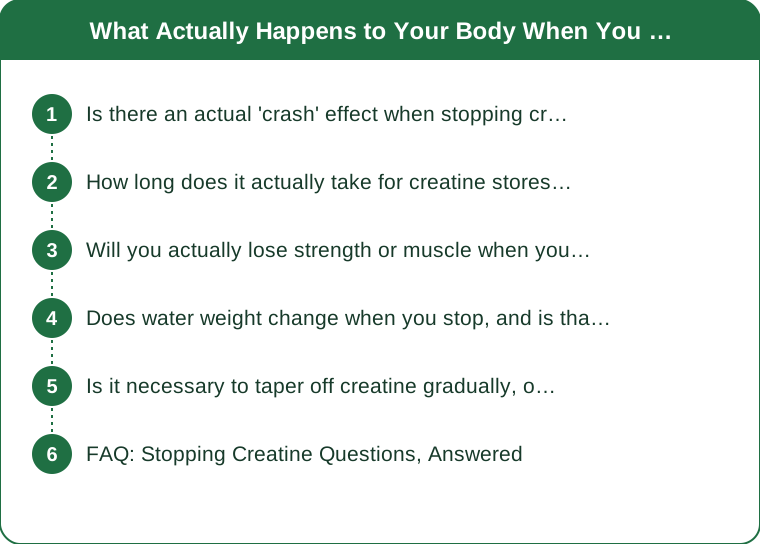
Is there an actual ‘crash’ effect when stopping creatine?
No — this is a common misconception. Creatine isn’t a stimulant and doesn’t work through a mechanism that produces withdrawal or crash effects. What happens instead is a gradual decline in muscle creatine stores back toward your body’s natural, pre-supplementation baseline, over a period of weeks, not a sudden drop.
How long does it actually take for creatine stores to return to baseline?
Generally around 4-6 weeks for muscle creatine levels to gradually return to your body’s natural baseline after stopping supplementation, based on the research available on creatine loading and washout — this is a slow, steady decline rather than an abrupt change.
Will you actually lose strength or muscle when you stop?
Some of the strength and performance benefit specifically attributable to elevated creatine stores may gradually fade as levels decline, but muscle built during your training period is not lost just from stopping creatine — any muscle gained through the training itself remains, assuming you continue training.

Does water weight change when you stop, and is that meaningful?
Creatine draws some water into muscle cells, so a modest reduction in this water retention is common after stopping, which can show up as a small change on the scale — this reflects water shifts, not fat or muscle loss, and isn’t something to be concerned about.
Is it necessary to taper off creatine gradually, or is stopping abruptly fine?
There’s no evidence-based need to taper — stopping abruptly is generally considered safe, since the decline in stores happens gradually on its own regardless of whether you stop cold or attempt a gradual reduction.
FAQ: Stopping Creatine Questions, Answered
Is it bad to cycle on and off creatine periodically?
There’s no strong evidence that cycling is necessary or provides additional benefit over continuous use, though some people choose to cycle for personal reasons without clear harm either way.
Will restarting creatine after a break require reloading?
A loading phase can speed up the return to elevated stores, but it’s not strictly necessary — consistent daily dosing without loading will also gradually rebuild stores, just somewhat more slowly.
Does stopping creatine affect kidney function or other health markers?
No evidence suggests stopping creatine specifically causes any negative health effect — any theoretical kidney concerns associated with creatine use, which remain largely unsupported in healthy individuals, aren’t relevant to the act of stopping.
TL;DR:
- There’s no real ‘crash’ or withdrawal effect from stopping creatine
- Muscle creatine stores gradually decline to baseline over roughly 4-6 weeks
- Muscle built during training is not lost just from stopping supplementation
- A modest reduction in water weight is normal and not a sign of fat or muscle loss
This is general information, not medical advice — individual responses vary, and anyone with a specific health condition should check with a doctor before starting or stopping any supplement.
Keep Reading
This article is for general informational purposes only and is not medical advice. Always consult a qualified health professional for guidance specific to you.