Creatine: The Questions Women Actually Ask, Answered Directly
Quick Answer: Creatine monohydrate is one of the most studied supplements available, and the evidence in women is broadly the same as in men: around 3-5g daily, taken consistently, improves performance in repeated high-intensity efforts and supports training adaptation. The commonly feared side effects - bloating, hair loss, kidney damage - are either short-lived, poorly supported, or not found in healthy people. What follows is each question answered on its own.
Every creatine article buries the actual questions under three paragraphs about phosphocreatine.
So this is just the questions, in the order people ask them.
This is general information, not medical advice. If you have kidney disease, are pregnant or breastfeeding, or take regular medication, discuss supplements with a doctor first.

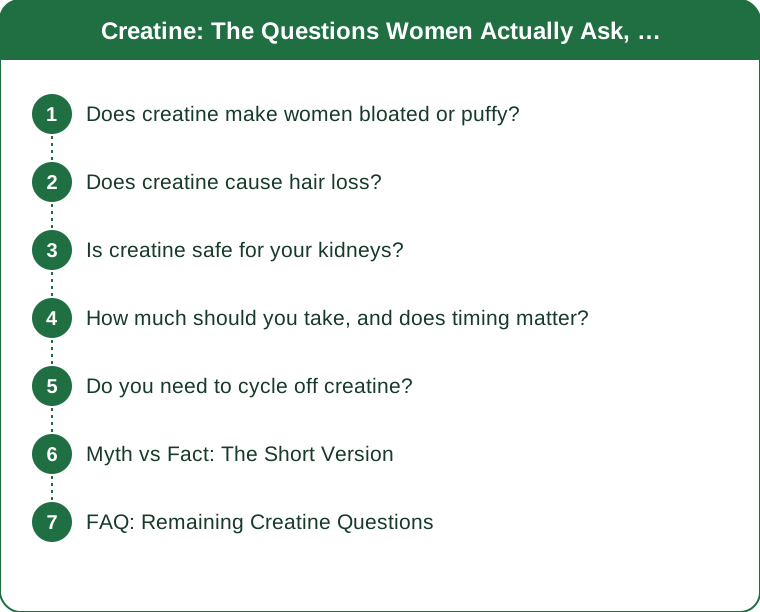
Does creatine make women bloated or puffy?
Short answer: there is an increase in total body water, it is intracellular rather than under the skin, and the noticeable phase is mostly tied to loading.
What actually happens. Creatine is stored in muscle and draws water into the muscle cell with it. That is intracellular water - inside the muscle - which is different from the subcutaneous water retention people picture when they think of looking puffy.
Why the bloating reputation exists. Loading protocols - typically around 20g daily split into four doses for five to seven days - cause a rapid increase in total body water, often cited in the range of one to two kilograms. That happens fast enough to be noticeable on the scale and sometimes in how clothes fit.
### Can you avoid it?
Largely, yes. Skipping the loading phase and taking 3-5g daily from the start reaches full muscle saturation in roughly three to four weeks instead of one. The same endpoint, without the rapid water shift. For most people not preparing for a specific event, there is no compelling reason to load.
### What about digestive bloating specifically?
Some people report stomach discomfort, and it is usually dose-related. Taking a large amount at once, or taking it with insufficient fluid, is the common cause. Splitting the dose or taking it with food generally resolves it. Micronised creatine monohydrate dissolves more completely, which some people find easier on the stomach.
### Does the water weight go away?
The intracellular water persists while you continue supplementing, because it is part of how the supplement works. It is not fat gain, and it is not the kind of water retention that shows as facial or ankle puffiness. If you stop, it returns to baseline over a few weeks.
Does creatine cause hair loss?
Short answer: this comes from a single small study that has never been replicated, and the study did not measure hair loss at all.
The origin. A 2009 study in rugby players found that creatine supplementation increased DHT - dihydrotestosterone - a hormone associated with androgenetic hair loss in people genetically predisposed to it. The study had 20 participants, ran for three weeks, and did not measure hair loss. It measured a hormone.
### Has it been replicated?
Not in a way that supports the concern. Subsequent reviews of the creatine literature have consistently noted that no studies have demonstrated an effect on hair loss, and the DHT finding itself has not been reliably reproduced. A 2021 review specifically examining creatine side effects concluded the evidence does not support a hair loss link.
### Should women be concerned specifically?
Female pattern hair loss involves androgens differently than male pattern, and there is no evidence base showing creatine affects it. If you have existing androgenetic hair loss and want to be cautious, that is a reasonable personal choice - but it would be based on one hormone measurement in 20 men, not on observed hair outcomes.
### Why does the claim persist?
Because it is a plausible-sounding mechanism attached to a real study, and mechanism-based claims spread far more easily than the replication failures that follow them. The honest position is that a single unreplicated hormonal finding does not establish an outcome nobody has measured.
Is creatine safe for your kidneys?
Short answer: in healthy people, the long-term evidence does not show kidney damage. In existing kidney disease, it is a genuine question for a doctor.
Where the concern comes from. Creatine breaks down into creatinine, which is what kidney function blood tests measure. Supplementing raises blood creatinine. That can look like impaired kidney function on a routine test when kidney function is entirely normal.
### So is the test result meaningless?
Not meaningless, but it needs context. Tell your doctor you take creatine before a blood test - otherwise an elevated creatinine may be interpreted as a kidney issue. Cystatin C is an alternative marker that is not affected by creatine supplementation and can be used if there is genuine uncertainty.
### What does the long-term evidence show?
Studies extending to several years in healthy people, including athletic populations, have not found adverse kidney effects at standard doses. Major sports nutrition position stands have concluded that creatine monohydrate is safe for healthy individuals at recommended doses.
### Who should be more careful?
Anyone with existing kidney disease or reduced kidney function, anyone on medications that affect the kidneys, and anyone pregnant or breastfeeding - not because harm is established, but because the evidence in those groups is limited. These are genuine discuss-with-your-doctor situations rather than blanket warnings.
### Does hydration matter?
Drinking adequate water is sensible and generally recommended alongside creatine. The old advice that creatine causes dehydration or cramping has not held up - reviews have generally found no increase in cramping or heat illness, and some studies suggest the opposite.

How much should you take, and does timing matter?
Short answer: 3-5g daily, every day, and timing matters far less than consistency.
The dose. 3-5g of creatine monohydrate daily is the standard maintenance dose across the literature. Larger people may sit at the higher end, with some guidance suggesting scaling by body mass, but the difference is small at typical body sizes.
### Do you need a loading phase?
No. Loading - roughly 20g daily for five to seven days - saturates muscle stores faster. Taking 3-5g daily reaches the same saturation in three to four weeks. Load only if you have a specific reason to want the effect quickly.
### Before or after training?
The evidence for timing is weak and the effect sizes are small. Some studies favour post-workout marginally; others find no difference. Muscle saturation is what matters, and that is a function of taking it every day rather than of the hour.
### What about rest days?
Take it. Saturation is maintained by daily intake, not by training. Skipping rest days is the most common way people fail to reach full saturation.
### Which form should you buy?
Creatine monohydrate. It has by far the largest evidence base and is the cheapest form. HCl, buffered, liquid and other variants are more expensive and have not demonstrated superiority in the research. Look for third-party testing if purity matters to you.
### Does it need to be taken with carbs or juice?
Insulin can enhance creatine uptake, so taking it with a meal containing carbohydrate may help marginally. In practice, at 3-5g daily over weeks, saturation happens regardless. It is not worth engineering a meal around.
Do you need to cycle off creatine?
Short answer: no, and the reasoning behind the cycling advice does not hold up.
The claim. That continuous use downregulates your body’s own creatine production, or that receptors become desensitised, so you need periodic breaks.
### What actually happens to endogenous production?
Your body’s own creatine synthesis does decrease somewhat during supplementation, which is a normal regulatory response. It returns to baseline after stopping, and there is no evidence of permanent suppression.
### Is there evidence that cycling improves outcomes?
No. Studies of continuous long-term use have not shown diminishing effectiveness requiring a break. Cycling means spending part of the year at sub-saturated muscle stores, which is the opposite of what you want.
### What if you stop?
Muscle creatine stores return to baseline over roughly four to six weeks. You would lose the performance benefit and the associated water. Nothing dramatic happens.
### Does it matter more or less for women?
Some research suggests women may have lower baseline muscle creatine stores than men, which has led to interest in whether the potential benefit is proportionally larger. That is an active area rather than a settled finding. The practical dosing advice is the same.
### Is there anything beyond muscle worth knowing?
Research into creatine and cognition, mood and bone health is ongoing, with some interesting early findings particularly around sleep deprivation and cognitive performance. It is genuinely promising and genuinely preliminary - not a reason to start taking it, and a reason to keep an eye on the literature.
Myth vs Fact: The Short Version
Myth: Creatine is a steroid. Fact: It is a compound found in meat and fish and produced by your own body. The mechanism has nothing in common with anabolic steroids.
Myth: It will make you bulky. Fact: It supports your ability to train harder, which over time supports muscle adaptation. It does not produce muscle on its own, and the rate of change is the same as any other training-driven adaptation.
Myth: You need to drink an enormous amount of water with it. Fact: Normal adequate hydration is sufficient. The dehydration and cramping concerns have not been supported by the research.
Myth: Women need a lower dose. Fact: Dosing scales loosely with body size rather than sex. 3-5g is standard, and most guidance does not differentiate.
Myth: It stops working after a few months. Fact: Saturation is maintained with continued daily intake. Perceived plateaus are training plateaus, not creatine ones.
Myth: The expensive forms work better. Fact: Monohydrate has the largest evidence base and is usually the cheapest. Newer forms have not demonstrated superiority.
FAQ: Remaining Creatine Questions
Can I take it while trying to lose weight?
Yes. The added water is intracellular and does not represent fat gain, though it can make the scale less informative for a few weeks. Creatine supports training performance during a calorie deficit, which is when preserving muscle matters most.
Does it interact with caffeine?
An old study suggested caffeine might blunt creatine’s effect, and it has not been consistently replicated. Most people take both without apparent issue. There is no strong reason to separate them.
Can vegetarians expect a bigger effect?
Possibly. Dietary creatine comes mainly from meat and fish, so vegetarians tend to have lower baseline muscle stores and some studies suggest a larger response to supplementation. It is one of the clearer cases for supplementing.
Will it help if I only do cardio?
The strongest evidence is for repeated high-intensity efforts - sprints, intervals, resistance work. For steady-state endurance alone, the performance benefit is smaller. It is not useless, just less targeted.
Should I take it during pregnancy or breastfeeding?
This is a doctor conversation. The evidence base in these populations is limited, which means caution rather than established risk.
How long until I notice anything?
With 3-5g daily and no loading, muscle stores saturate over three to four weeks. Performance effects show up in training - an extra repetition or two on hard sets - rather than as a feeling.
TL;DR:
- 3-5g of creatine monohydrate daily, every day including rest days; loading is optional and mostly explains the bloating reputation
- The water increase is intracellular, not subcutaneous puffiness
- The hair loss claim traces to one small unreplicated study that measured a hormone, not hair
- Long-term studies in healthy people show no kidney harm; tell your doctor before blood tests because it raises creatinine readings
- Timing barely matters; consistency does
- No need to cycle off - continuous use does not lose effectiveness
Monohydrate, five grams, daily, cheap. Almost everything else in the category is marketing.
Keep Reading
This article is for general informational purposes only and is not medical advice. Always consult a qualified health professional for guidance specific to you.