Creatine Questions People Actually Ask in Month Three
Quick Answer: By month three the common questions change: whether the initial weight gain is going to keep going (it does not), whether you still need to take it on rest days (yes, and it matters more than timing), whether it stops working (it does not, but the noticeable gains do plateau), and whether cycling off is necessary (there is no good evidence that it is).
Month one questions are about loading, timing, and whether the water weight is real.
Month three questions are different, and much harder to find good answers to, because most of the content online is written for people who have not started yet.
These are the ones that actually come up.

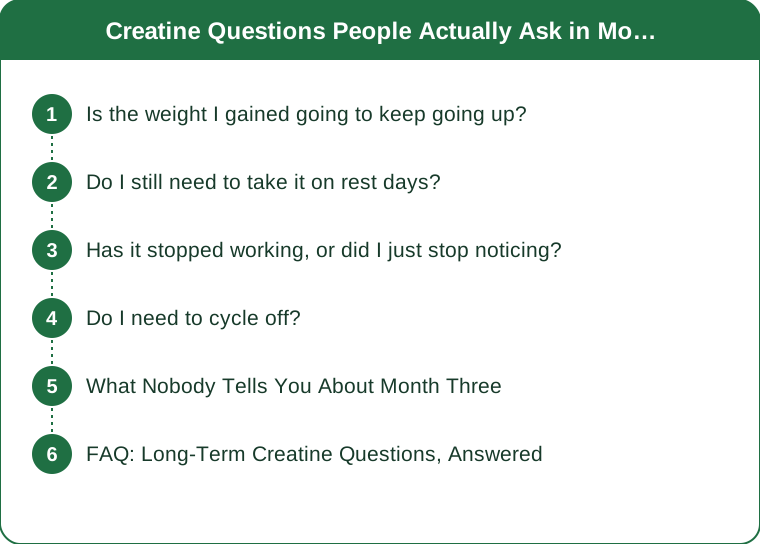
Is the weight I gained going to keep going up?
No. The intracellular water increase is essentially a one-time step change, and it is over well before month three.
Here is the shape of it. Creatine draws water into muscle cells, and that shows up on the scale as roughly one to two kilograms in the first two to four weeks — faster if you loaded at 20g a day, more gradually if you went straight to 3–5g. Once your muscle creatine stores are saturated, they are saturated. There is no mechanism by which continued daily dosing keeps adding water indefinitely.
So if you are still gaining in month three, creatine is not what is doing it. The plausible candidates are the ordinary ones: you are eating more, you are gaining muscle from training, or normal week-to-week fluctuation is being read as a trend.
Two things worth knowing:
The gain is intracellular, not subcutaneous. Water inside the muscle cell is not the same as water under the skin, and it does not produce a softer look — if anything the opposite.
It reverses if you stop. Discontinue and the extra water clears over roughly two to six weeks. This is why people who stop before a holiday see a quick drop and conclude the whole thing was fake. It was not fake, it was just water, and water was never the point.
If the scale genuinely matters to you for a sport with weight classes, that one-time step is worth planning around. Otherwise it is noise.
Do I still need to take it on rest days?
Yes, and by month three this is the question that actually matters more than any timing question.
The mechanism is simple. Creatine works by keeping muscle stores saturated. Saturation is a function of total daily intake over time, not of any single dose landing at a clever moment. Your muscle does not know it is a rest day.
Your body loses roughly 1 to 2 grams of creatine per day through normal turnover, mostly as creatinine excreted in urine. That loss happens whether or not you train. Skip your rest-day doses and you are running a small daily deficit two or three days a week, which over a month drifts your stores down from full.
The practical version:
- Take the same 3–5g every day. Training days, rest days, holidays, travel.
- Do not try to “make up” a missed day by doubling. It does not work that way, and larger single doses mostly increase the chance of stomach upset.
- Missing one day is genuinely nothing. Saturation is a slow-moving reservoir. Missing a week starts to matter.
The corollary is that all the pre-workout versus post-workout debate is far less important than most people think at month one. The difference between timings is small and inconsistently demonstrated. The difference between taking it every day and taking it four days a week is not small.
Take it whenever you will reliably remember. That is the entire optimisation.
Has it stopped working, or did I just stop noticing?
Almost always the second one, and the distinction is worth being precise about.
The dramatic part of creatine is front-loaded. In the first four to six weeks you get the saturation effect: a genuine bump in the number of reps you can do at a given load, a bit more volume per session, slightly better recovery between sets. That is a visible jump, and it is over quickly because it is a one-time change in a physiological buffer.
After that, creatine is not producing gains. Your training is producing the gains, and creatine is letting you train slightly harder than you otherwise could. That is a permanent advantage, but it is an invisible one, because you have no way of observing the version of the last two months where you were not taking it.
So how do you tell whether it is still doing anything?
Check your training log, not your feelings. If your total weekly volume at a given load is higher than it was in month one, the thing is working.
Do not test by stopping. Detraining, fatigue, sleep, and normal variation will all contaminate a two-week self-experiment beyond usefulness.
Watch the last set, not the first. Creatine’s effect is largest in repeated high-effort bouts. If your fifth set looks more like your second than it used to, that is where you would expect to see it.
One legitimate cause of things genuinely getting worse: stores are not saturated. Inconsistent dosing, a dose that is too small for a larger person, or an unreliable product. Before concluding it stopped working, check that you have actually been taking 3–5g every day for the last month.

Do I need to cycle off?
There is no good evidence that you do, and the reasoning behind the idea does not really hold up.
The cycling concept is imported from compounds where receptor downregulation or suppression of endogenous production is a real concern. Creatine is neither. It is a substrate your body already uses and already synthesises, at roughly 1g a day from the liver, kidneys, and pancreas.
The specific worry is usually that supplementing shuts down your own production permanently. Endogenous synthesis does downregulate somewhat while you are supplementing — which makes sense, since your stores are full — and the available evidence indicates it returns to normal after you stop. There is no demonstrated permanent suppression.
Long-term safety data in healthy adults is unusually good for a supplement, with studies running for months to several years at standard doses without adverse findings in kidney or liver markers.
That said, a few genuine caveats:
- Existing kidney disease is a real exception. If you have any kidney condition, or you are on medication that affects kidney function, this is a conversation to have with your doctor rather than a decision to make from an article.
- Creatinine on a blood test will read slightly high. This is a measurement artefact of taking creatine, not evidence of damage — but tell whoever ordered the test that you supplement, otherwise it can trigger an unnecessary chase.
- If you stop for a month, you will lose the effect and need three to four weeks at 3–5g to get it back. There is no benefit to buying yourself that.
This is general information, not medical advice.
What Nobody Tells You About Month Three
A few things that only show up once you are past the beginner phase.
Your dose may be too small if you are larger. The standard 3–5g recommendation is built around average body size. Muscle mass is the main determinant of how much creatine you store, so someone substantially heavier or more muscular sits at the top of that range rather than the bottom, and possibly slightly above it.
Caffeine and creatine are fine together. The old idea that caffeine blunts creatine’s effect comes from a small study and has not held up well. Practically, most people take both daily with no issue.
The gritty residue at the bottom of the glass is undissolved creatine you did not take. Monohydrate dissolves slowly in cold water. Use warmer water, stir and let it sit for a minute, or simply top the glass up and drink the rest.
Stomach discomfort is nearly always a dose-size problem, not a creatine problem. Splitting 5g into two 2.5g doses with food resolves it for most people.
Plain monohydrate is still the correct choice. The alternatives — HCl, buffered, liquid, ethyl ester — are more expensive and none of them have shown a meaningful advantage over monohydrate in head-to-head work. There is a good argument for choosing a product with third-party testing. There is no good argument for paying more for a fancier molecule.
It is not only a lifting supplement. There is genuine and growing interest in cognitive effects, particularly under sleep deprivation, and in older adults maintaining muscle. Neither is a reason to change what you are doing, but it is context for why the daily habit is worth keeping.
FAQ: Long-Term Creatine Questions, Answered
Should I increase my dose as I gain muscle?
If you have added substantial muscle mass, moving from 3g to 5g is sensible, since storage capacity scales with muscle. Beyond 5g there is little reason to go higher for most people — excess is simply excreted.
Does it matter if I take it with food or on an empty stomach?
Uptake is modestly better alongside carbohydrate and protein, because of the insulin response. The effect is small and not worth restructuring your day for. Taking it with a meal is a good default mostly because meals are the most reliable daily reminder available.
Is it a problem to take creatine on days I do a long run or ride?
No. The extra intracellular water has been raised as a theoretical concern for endurance athletes in heat, but the evidence for any real performance downside is weak, and creatine does not impair thermoregulation as was once assumed. Stay hydrated as you normally would in the heat.
TL;DR:
- The early weight gain is a one-time water shift that ends within a month — it does not keep climbing
- Take the same 3–5g every day including rest days; consistency beats timing by a wide margin
- It has not stopped working, it has stopped being noticeable — check your training log, not your feelings
- There is no good reason to cycle off, with kidney disease as the genuine exception to discuss with a doctor
- Plain monohydrate remains the right product, and undissolved grit at the bottom of the glass is a dose you did not take
Month three is where creatine becomes boring, and boring is what it is supposed to be. It is not a phase you are doing. It is a small daily thing that makes the training you were already doing count for slightly more.
Keep Reading
This article is for general informational purposes only and is not medical advice. Always consult a qualified health professional for guidance specific to you.