Creatine Monohydrate Loading Phase: Your Questions, Answered
Quick Answer: A loading phase is 20 g of creatine monohydrate daily, split into four 5 g doses, for 5 to 7 days — then 3 to 5 g daily to maintain. It saturates your muscle stores in about a week instead of about a month. It is entirely optional: 3 to 5 g daily from the start reaches the same saturation point, just more slowly, with less risk of stomach upset.
Every label says something different, and half the internet says loading is pointless.
Both positions are defensible, because loading only changes how fast you get there. Here is everything that actually determines whether it is worth doing.

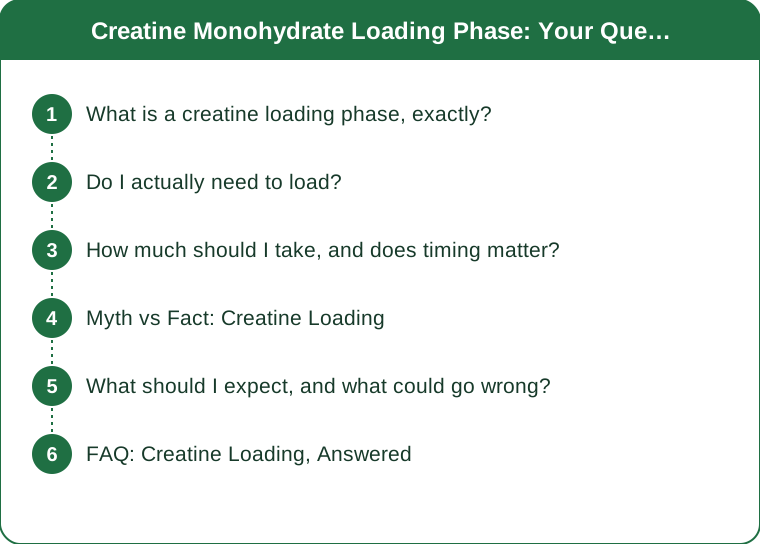
What is a creatine loading phase, exactly?
It is a short high-dose period at the start of supplementation, designed to saturate muscle creatine stores quickly.
The standard protocol: 20 g of creatine monohydrate per day, split into four separate 5 g doses, for 5 to 7 days. After that you drop to a maintenance dose of 3 to 5 g daily and stay there.
The splitting matters. Your body absorbs creatine efficiently in roughly 5 g increments; taking 20 g in one sitting increases the chance of stomach discomfort and does not improve uptake.
The mechanism: your muscles hold a finite pool of creatine, typically around 60 to 80 percent full on a normal omnivorous diet. The performance benefits come from filling that pool. Loading pushes it to near-saturation within about a week; 3 to 5 g daily reaches the same place in roughly three to four weeks.
The end point is identical. Loading is a schedule decision, not a dose-response one — you cannot exceed saturation, and taking more once you are full does nothing but pass through.
Which reframes the entire question: do you need the benefit three weeks earlier?
Do I actually need to load?
No, in the sense that you reach the same destination either way. Whether it is worth it depends entirely on timing.
Loading makes sense if:
- You have a specific event, season start, or training block beginning in one to two weeks
- You are starting a program now and want the effect during the first month rather than after it
- You are a vegetarian or vegan, whose baseline muscle creatine tends to be lower and who often shows a larger response — reaching saturation faster is more noticeable here
Skipping the load makes sense if:
- You have no deadline, which describes most people
- You are prone to stomach upset — GI discomfort is the most common complaint and it scales with dose
- You want to minimize the initial water weight, which arrives faster and more noticeably with loading
- You want to spend less on the first week, though the amount is trivial
The honest default for most people: skip loading, take 3 to 5 g daily, and be fully saturated in about a month. Simpler, gentler, and identical after week four.
How much should I take, and does timing matter?
Loading: 20 g daily, as four 5 g doses spread through the day, for 5 to 7 days. Some protocols scale by body weight at roughly 0.3 g per kg per day, which produces a similar figure for most people.
Maintenance: 3 to 5 g daily, indefinitely. Larger individuals and those with more muscle mass sit at the higher end. There is no benefit to exceeding this once saturated.
Timing: it matters far less than consistency. Muscle saturation is a slow-moving pool — what matters is total daily intake over weeks, not which hour it went in. Take it whenever you will reliably remember.
A few small points that do have some support:
- Taking it with a meal containing carbohydrate and protein may slightly improve uptake via the insulin response. A minor effect, and not worth engineering your day around.
- Post-workout has marginally better evidence than pre-workout, but the difference is small enough that adherence should decide it.
- Consistency on rest days matters. People commonly skip non-training days, which slowly drops saturation. Take it every day.
Dissolve it in warm water if it settles. Creatine monohydrate is not highly soluble in cold liquid, and grit at the bottom of the glass is creatine you did not consume.

Myth vs Fact: Creatine Loading
Myth: Loading gets you better results than not loading. Fact: It gets you the same results sooner. Once saturated, someone who loaded and someone who did not are in an identical state.
Myth: You need to cycle creatine on and off. Fact: There is no evidence supporting cycling. Your body does not downregulate in a way that requires breaks, and stopping simply lets stores fall back toward baseline over about four to six weeks.
Myth: The weight gain during loading is fat. Fact: It is intracellular water — creatine draws water into muscle cells. Typically 2 to 4 lb, it arrives in the first week or two, and it is water inside muscle rather than subcutaneous bloating. It does not make you look puffy.
Myth: Creatine damages your kidneys. Fact: In healthy individuals, decades of research have not shown kidney harm at standard doses. It does raise serum creatinine, a lab marker used to estimate kidney function, which can produce a confusing result — tell your doctor you take creatine before any kidney panel. Anyone with existing kidney disease should discuss it with their doctor first.
Myth: Women should take less. Fact: Dosing scales with body size and muscle mass rather than gender. A smaller person takes less because they are smaller. The research in women is increasingly positive, including for cognitive and mood outcomes.
Myth: Loading is the only way to feel a difference quickly. Fact: What people feel in the first week is largely the water shift, which happens either way — just faster with loading.
What should I expect, and what could go wrong?
During a loading week: most people notice 2 to 4 lb of weight gain from intracellular water within the first week or two. Some notice slightly fuller-looking muscles. Strength effects generally take a few weeks of training to become apparent, since creatine improves your capacity to do work rather than adding strength directly.
The most common side effect is GI discomfort — bloating, cramping, or loose stools. It is dose-related, which is exactly why splitting into 5 g doses matters and why skipping the load avoids it entirely. If it happens, drop to 3 to 5 g daily and it typically resolves.
Hydration. Creatine pulls water into muscle, so drink normally to generously, particularly during a loading week and in summer heat.
What to buy: plain creatine monohydrate, ideally with third-party testing such as NSF Certified for Sport or Informed Sport. Micronized simply means finer powder — easier to dissolve, same molecule. The exotic forms (HCl, ethyl ester, buffered) cost more and none have shown superiority over monohydrate, which remains the most researched supplement in sports nutrition.
Talk to your doctor first if you have kidney or liver disease, are pregnant or breastfeeding, are taking medications that affect kidney function, or are under 18. This is general information, not medical advice.
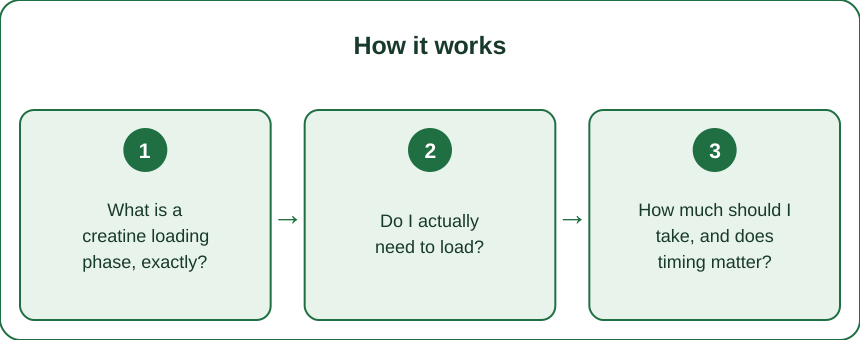
FAQ: Creatine Loading, Answered
What happens if I miss a day during loading?
Nothing significant. Resume the next day and extend the loading phase by a day if you want. Saturation is a cumulative process over a week; a single missed dose does not reset anything.
Can I load with something other than monohydrate?
You can, but there is no reason to. Monohydrate is the form used in the overwhelming majority of research, it is the cheapest, and no alternative form has demonstrated superior saturation or results.
How long until I lose saturation if I stop?
Muscle creatine levels return toward baseline over roughly four to six weeks after stopping. The water weight goes first, within a week or two, which is why people often think the effect vanished faster than it did.
Do I need to load again after a break?
Only if you want the benefit back quickly. After a few weeks off, either load for 5 to 7 days or simply restart 3 to 5 g daily and be saturated again in three to four weeks.
TL;DR: Loading changes the timeline, not the destination.
- The protocol is 20 g daily in four 5 g doses for 5 to 7 days, then 3 to 5 g daily to maintain.
- 3 to 5 g daily from the start reaches identical saturation in about three to four weeks. Both end up the same place.
- Load if you have a deadline — a season, an event, a program starting now — or if you are vegetarian or vegan.
- Skip it otherwise. Less stomach upset, less abrupt water weight, and simpler.
- Timing barely matters; consistency does. Take it on rest days too.
- The 2 to 4 lb gain is intracellular water, not fat, and it happens either way.
- Buy plain third-party-tested monohydrate. The expensive forms have not beaten it.
If you have no deadline, 5 g a day and forget about it is the correct answer.
Keep Reading
This article is for general informational purposes only and is not medical advice. Always consult a qualified health professional for guidance specific to you.