Do You Need a Creatine Loading Phase? What It Actually Does for Women
Quick Answer: A creatine loading phase (typically 20 grams a day for 5-7 days, then dropping to a 3-5 gram maintenance dose) saturates your muscles with creatine faster than a standard dose alone, but it is not required - taking 3-5 grams daily without loading reaches the same saturation point, just over about 3-4 weeks instead of 1 week. For most women, skipping the loading phase and starting at maintenance dose is a perfectly effective, often more comfortable option.
Creatine loading phase advice gets repeated as a default step without much explanation of what it actually does or whether it is necessary. Here is a direct breakdown, with the specifics for women’s bodies and training goals.

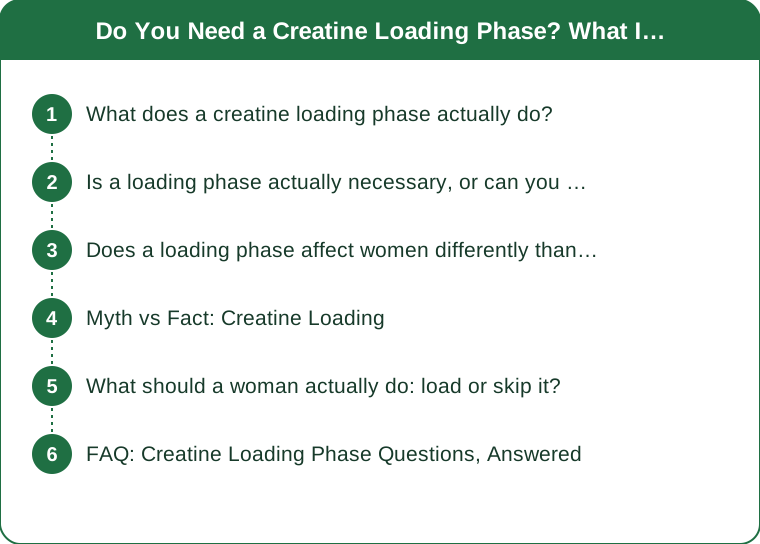
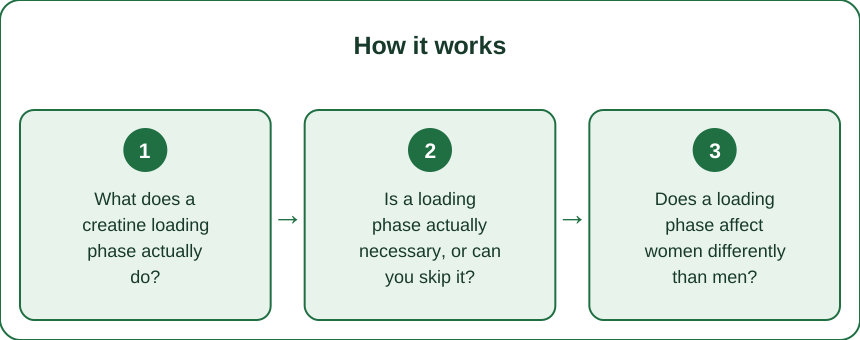
What does a creatine loading phase actually do?
A loading phase means taking a higher dose - commonly 20 grams a day, split into 4 doses of 5 grams, for 5-7 days - to saturate your muscle creatine stores faster than a standard daily dose would. Once stores are saturated, you drop to a 3-5 gram maintenance dose to keep them topped off.
Does loading make creatine work better long-term?
No - loading only affects how quickly you reach full muscle saturation, not how effective creatine is once you get there. Someone who loads and someone who skips loading end up at the same saturation point and the same long-term benefits; the only real difference is the timeline to get there.
Is a loading phase actually necessary, or can you skip it?
It is genuinely optional. Taking 3-5 grams daily without any loading phase reaches full muscle saturation in about 3-4 weeks, compared to about a week with loading - both paths land in the same place. Skipping the loading phase is a completely legitimate, evidence-supported approach, not a shortcut that compromises results.
Why do some people load anyway if it is not necessary?
Mostly for faster results before a specific event, competition, or training block where the extra week of full saturation matters for timing. For general, ongoing use, there is little practical reason to load.
Does a loading phase affect women differently than men?
The core mechanism of creatine saturation does not differ by sex, but a few practical factors matter for women specifically: loading doses (20g/day) are calculated the same regardless of body size, meaning a smaller-framed woman is often taking a proportionally larger dose relative to her body weight than a larger man on the same protocol, which can increase the likelihood of the temporary bloating some people experience during loading.
Does this mean women should use a lower loading dose?
Some women choose to scale loading dose to body weight (roughly 0.3 grams per kilogram of body weight per day) instead of a flat 20 grams, which can reduce bloating while still accelerating saturation - though skipping loading altogether avoids this issue entirely.
What kind of bloating are we actually talking about?
Most commonly it’s a mild, temporary sense of fullness or slight water weight gain (often 1-3 pounds), not significant digestive distress. It tends to resolve within the first 1-2 weeks as your body adjusts, regardless of whether you continue with a loading protocol or move to a maintenance dose instead.

Myth vs Fact: Creatine Loading
Myth: You will not see any benefit from creatine until you complete a loading phase. Fact: Benefits build gradually as saturation increases either way - loading just compresses the timeline, it does not gate whether you get benefits at all.
Myth: Loading causes permanent water retention. Fact: The water retention some people notice during loading is temporary and related to creatine drawing water into muscle cells, which is part of its normal mechanism - it typically stabilizes once you move to maintenance dose.
Myth: Skipping loading means creatine will not work as well for you. Fact: Skipping loading only changes the speed of reaching saturation, not the ceiling of benefit once you get there.
Myth: Loading is only relevant for serious athletes, not everyday gym-goers. Fact: The mechanism works identically regardless of training background - a loading phase is simply a timeline choice, equally available and equally optional whether your goal is competitive performance or general fitness.
What should a woman actually do: load or skip it?
If you want faster results and do not mind a week of higher dosing (and any temporary bloating), loading is a reasonable choice. If you prefer a gentler start, want to avoid the higher likelihood of GI discomfort or bloating during loading, or simply are not in a rush, starting directly at a 3-5 gram daily maintenance dose is equally effective long-term.
Is there a wrong choice here?
Not really - both are well-supported approaches. The main practical downside of loading is short-term comfort (bloating, occasional stomach upset for some people); the main downside of skipping loading is simply a longer wait to reach full saturation, which for most non-competitive goals does not matter much.
Does the specific type of creatine matter much for this particular decision?
Creatine monohydrate is by far the most researched form and works well with either dosing approach described above. Some newer forms marketed as reducing bloating may make a loading phase more comfortable, though monohydrate still remains the single most evidence-backed and cost-effective option currently available, regardless of which dosing strategy you ultimately end up choosing to follow.
FAQ: Creatine Loading Phase Questions, Answered
How long does a maintenance dose take to reach full saturation without loading?
Typically around 3-4 weeks of consistent daily 3-5 gram dosing, compared to about a week with a loading phase.
Is it safe for women to do a full loading phase?
Generally yes for healthy adults, though anyone with kidney concerns or other health conditions should check with a doctor before starting any creatine protocol, loading or otherwise. This is general information, not medical advice.
Can I switch from a loading phase to skipping it, or vice versa, partway through?
Yes - you can stop a loading phase early and drop to maintenance dose anytime, or start with maintenance dose and add a short loading period later if you want faster saturation for an upcoming event.
Do I need to cycle off creatine periodically, regardless of loading?
Most current research does not support a need for regular cycling off creatine - continuous daily use at a maintenance dose is generally considered safe for healthy adults over the long term, though individual circumstances vary quite a bit, and checking with a doctor first is always reasonable if you have any underlying health concerns, especially pre-existing kidney or liver conditions worth considering carefully.
TL;DR:
- A loading phase (20g/day for 5-7 days) speeds up muscle saturation but is not required
- Skipping loading and taking 3-5g daily reaches the same saturation point in about 3-4 weeks
- Women may notice more bloating during loading relative to body size - scaling dose to body weight can help
- Both loading and skipping are equally effective long-term; it is a comfort and timeline choice, not a results choice
This is general information, not medical advice - check with a doctor before starting creatine if you have kidney concerns or another health condition.
Keep Reading
This article is for general informational purposes only and is not medical advice. Always consult a qualified health professional for guidance specific to you.