Does Creatine Actually Cause Hair Loss? What the One Study Everyone Cites Really Found
Quick Answer: The creatine-hair-loss concern comes almost entirely from one small 2009 rugby player study that found increased DHT (a hormone linked to hair loss) levels — but that study never actually measured hair loss itself, and no study since has replicated a direct creatine-to-hair-loss link.
Search ‘does creatine cause hair loss’ and you’ll find a confident yes from plenty of forums and a single study cited every time, usually without anyone linking to or actually reading the study itself. It’s worth actually understanding what that study found, and just as importantly what it didn’t, before deciding whether to worry about a supplement with an otherwise very strong overall safety record.

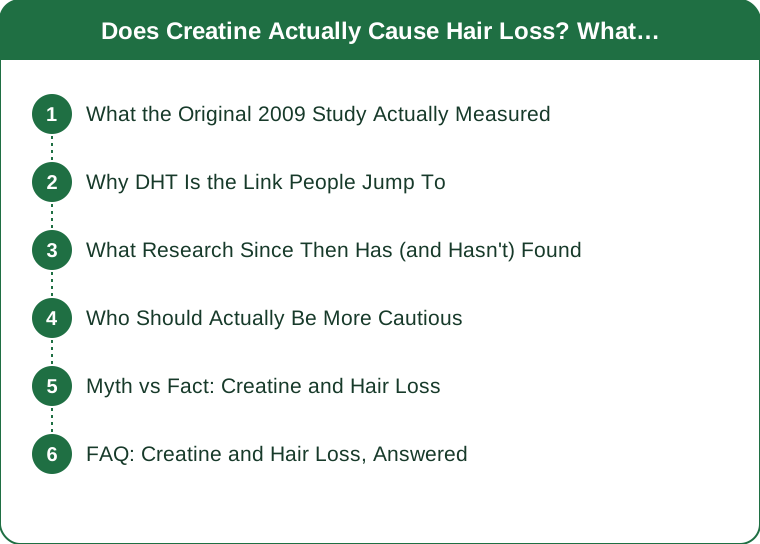
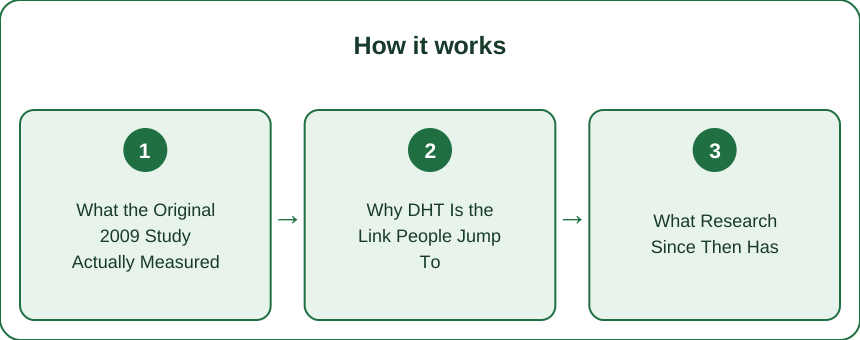
What the Original 2009 Study Actually Measured
The study, conducted on college-age rugby players, measured hormone levels — specifically testosterone and dihydrotestosterone (DHT) — before and after a creatine loading and maintenance protocol. It found a measurable increase in DHT levels in the creatine group compared to placebo, with DHT rising over the study period in a way that didn’t occur in the control group.
That’s the entire finding. The study did not measure hair follicles, hair shedding, hair density, or any actual hair loss outcome in participants — it stopped at the hormone measurement, which is a meaningfully different and much more limited finding than what the popular framing of the study usually implies.
Why DHT Is the Link People Jump To
DHT is a well-established contributor to androgenetic alopecia (male and female pattern hair loss) in people who are genetically predisposed to it, since DHT binds to hair follicle receptors and can gradually shrink follicles over time (a process called miniaturization) in susceptible individuals. The logic chain goes: creatine raised DHT in one study, DHT is linked to hair loss generally, therefore creatine causes hair loss — but that chain skips the actual missing step, which is whether creatine’s DHT increase translates into measurable hair loss in real users, a question the original study simply never tested.
What Research Since Then Has (and Hasn’t) Found
In the years since, no study has directly replicated a creatine-to-DHT link at the same magnitude, and no study has measured actual hair loss outcomes in creatine users compared to non-users. The overall evidence base remains genuinely thin in both directions — there isn’t strong evidence creatine causes hair loss, but there also isn’t a large body of research definitively ruling it out either, particularly for people already genetically predisposed to pattern hair loss, which leaves this in a genuinely unresolved state scientifically rather than settled in either direction.

Who Should Actually Be More Cautious
Am I at higher risk if I have a family history of hair loss?
People with a strong genetic predisposition to androgenetic alopecia (a family history of early pattern hair loss) are the group where the DHT-pathway concern is most biologically plausible, even without direct creatine-specific hair loss data, since they already have follicles more sensitive to whatever DHT elevation might occur.
Does the dose or duration of creatine use change the risk?
The original study used a standard loading and maintenance protocol similar to what’s commonly recommended, so there’s no clear evidence that a lower, no-loading-phase approach avoids the DHT effect entirely — though it also hasn’t been specifically tested as a variable, so this remains an open question rather than a settled one.
Should women be more or less concerned about this than men?
The original study only included male participants, so there’s genuinely no direct data on how this might apply to women, whose baseline hormone profiles and hair loss patterns differ meaningfully from men’s — this gap in the research is worth being upfront about rather than assuming the findings simply transfer over.
Myth vs Fact: Creatine and Hair Loss
Myth: this is a settled scientific fact everyone agrees on. Fact: the evidence base is genuinely thin and unresolved in both directions — it’s neither proven nor definitively ruled out, which is a meaningfully different and more honest position than either the confident forum claims or a dismissive ‘it’s totally fine’ response.
Myth: if creatine caused hair loss, we’d have seen it clearly by now given how widely it’s used. Fact: hair loss from androgenetic alopecia has a slow, gradual onset that’s genuinely hard to attribute to any single specific cause in a real-world setting without a controlled study specifically measuring it, which is exactly why the absence of widespread reports isn’t strong evidence of safety on its own either.
FAQ: Creatine and Hair Loss, Answered
Should I stop taking creatine if I’m worried about hair loss?
If you have a strong family history of early pattern hair loss and are concerned, discussing it with a doctor before starting (or continuing) creatine is reasonable given the thin evidence in both directions — for most people without that history, the concern is largely theoretical based on current research.
Is there a way to take creatine that avoids the DHT increase?
No dosing strategy has been specifically shown to avoid the DHT effect seen in the original study, since it appeared during both the loading and standard maintenance phases in that research.
Are there other, better-established side effects of creatine I should actually worry about instead?
Mild water retention and occasional GI discomfort are the most consistently documented side effects across the much larger body of creatine safety research — these have far stronger evidence behind them than the hair loss concern, and creatine overall has one of the most extensively studied safety profiles of any common supplement.
If I do decide to try creatine despite the hair loss concern, is there a way to monitor for it early?
Tracking normal daily hair shedding for a few weeks before starting, then comparing that baseline to shedding after a few months of use, is a more useful personal check than waiting to notice a dramatic change — a meaningful increase from your own established baseline is worth discussing with a doctor, while normal day-to-day shedding variation isn’t cause for alarm on its own.
Does creatine from food (like red meat) carry the same theoretical concern as supplemental creatine?
Dietary creatine intake is generally much lower than a standard supplemental dose, and there’s no specific research linking ordinary dietary creatine intake to the DHT finding from the supplement study, so this concern is really specific to supplemental dosing levels rather than everyday food sources.
This is general information, not medical advice — talk to a doctor about your specific risk factors before starting any new supplement.
TL;DR:
- The entire creatine-hair-loss concern traces back to one 2009 study that measured DHT, not actual hair loss
- DHT is linked to hair loss in genetically predisposed people, but the study never tested that connection directly
- No study since has replicated the DHT finding or measured real hair loss outcomes in creatine users
- The original study only included men, so there’s no direct data on how this applies to women
- People with a strong family history of early pattern hair loss have the most reasonable grounds for caution
The honest state of the evidence is ‘unresolved and understudied,’ not ‘proven to cause hair loss’ — worth knowing before either dismissing the concern entirely or treating it as settled fact.
Keep Reading
This article is for general informational purposes only and is not medical advice. Always consult a qualified health professional for guidance specific to you.