Creatine Gummies vs Powder: Are the Gummies Actually Worth It?
Quick Answer: Creatine gummies can work, but most brands deliver far less creatine per serving than powder and cost several times more per gram. The bigger issue is stability — creatine degrades into creatinine in moist, acidic environments, which is exactly what a gummy is. If you buy gummies, buy from a brand that third-party tests finished product, and expect to eat 5 to 8 of them for a standard daily dose.
Gummies solved a real problem: some people genuinely cannot tolerate the texture of creatine powder, and some people simply will not take a supplement that requires a scoop and a glass. Adherence beats optimisation.
But the format introduces problems the marketing does not mention, and the price difference is larger than most people realise until they do the arithmetic.

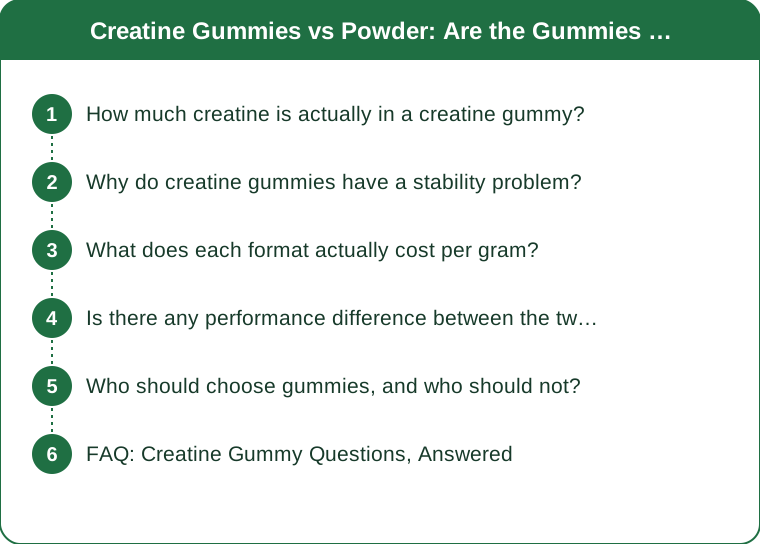
How much creatine is actually in a creatine gummy?
Far less than the label’s front panel implies, in most cases.
A standard evidence-based maintenance dose is 3 to 5 grams of creatine monohydrate daily. A typical gummy contains somewhere between 0.5 and 1.5 grams. That means a 5 gram dose requires anywhere from four to ten gummies depending on brand.
Check the serving size line, not the front of the bottle. A bottle advertising 5g of creatine per serving may define a serving as four gummies, which halves the number of days in the container and doubles your real cost. This is not deceptive labelling — it is just labelling most people do not read carefully.
There is a second arithmetic problem: sugar. Gummies need sugar or sugar alcohols to hold their structure. Four to eight gummies daily can add 10 to 25 grams of sugar or a comparable load of sugar alcohols, which for some people means daily digestive complaints they will not immediately connect to the supplement.
None of this makes gummies useless. It means the honest comparison is not one gummy versus one scoop, it is eight gummies plus their sugar versus one scoop.
Why do creatine gummies have a stability problem?
Creatine monohydrate is stable as a dry powder for years. In solution it slowly converts to creatinine, an inert breakdown product with no ergogenic effect, and that conversion accelerates with moisture, heat and acidity.
A gummy is a moist, warm-shipped, usually acidic product with a shelf life measured in months to years. That is close to a worst-case storage environment for creatine.
Independent testing over the past couple of years has repeatedly found gummy products containing substantially less active creatine than labelled — in some reported cases, dramatically less. The degradation is invisible: the gummy tastes the same, looks the same and weighs the same whether it contains 1 gram of creatine or nearly none.
What to do about it, practically:
- Prefer brands that publish third-party testing on the finished product, not on the raw ingredient. Testing the powder before it goes into the gummy tells you nothing about what survived.
- Look for a manufacture date, not just an expiry date, and prefer recent stock.
- Store the bottle somewhere cool and dry. A bathroom cabinet or a hot car is the fastest way to lose potency.
- Be sceptical of any gummy that has been sitting in a warehouse or on a shelf through a hot summer.
What does each format actually cost per gram?
This is where the decision usually gets made, and the gap is wide.
Powder: bulk creatine monohydrate typically runs about $0.05 to $0.15 per 5 gram serving at common retail prices. A 1kg tub is 200 servings and often costs $25 to $40, which works out to well under twenty cents a day.
Gummies: commonly land between $1.00 and $2.50 per 5 gram equivalent dose, once you account for how many gummies a full dose actually requires.
That is roughly a tenfold to twentyfold difference. Over a year of daily use, powder costs something like $30 to $50 and gummies commonly run $400 or more.
Whether that is worth it depends entirely on a question only you can answer: would you actually take the powder? A supplement you skip has an effectiveness of zero regardless of price per gram. If gummies are the difference between consistent use and a tub that sits unopened, they are cheap. If you would happily take powder and are buying gummies for novelty, you are paying a very large premium for flavour.

Is there any performance difference between the two formats?
Assuming the gummy actually contains the creatine it claims — no meaningful difference.
Creatine monohydrate is creatine monohydrate. It does not matter whether it arrives in water, in a smoothie, or suspended in pectin. Absorption of monohydrate is already close to complete, which is why fancier forms (HCl, ethyl ester, buffered) have consistently failed to beat plain monohydrate in head-to-head studies despite costing more.
So the format question is not really a physiology question. It is a question about dose accuracy and product integrity, and on both of those powder has a structural advantage: you can see the powder, you can weigh it, and it does not degrade meaningfully in the tub.
The one genuine physiological footnote: taking creatine with carbohydrate slightly improves muscle uptake, and a gummy comes with carbohydrate built in. The effect is small — it matters most during a loading phase and barely at all during maintenance — but it is a real point in the gummy column.
Who should choose gummies, and who should not?
Gummies make sense if:
- You have tried powder repeatedly and stopped, for texture, taste or logistical reasons. Adherence is the whole game.
- You travel constantly and cannot deal with scoops, tubs and shaker bottles. Gummies are genuinely more portable.
- You have a strong aversion to grit in drinks and micronised powder still bothers you.
- Cost is genuinely not a consideration for you.
Stick with powder if:
- You take creatine daily and expect to keep doing so for years. The cost difference compounds into real money.
- You are managing sugar intake, dental health or have GI sensitivity to sugar alcohols.
- You want certainty about dose. Weighing powder gives you a number; counting gummies gives you a claim.
- You are in a loading phase needing 20g daily, which would mean 16 to 40 gummies a day — impractical and expensive.
A reasonable middle path that many people land on: powder at home, a small bottle of gummies kept in a travel bag for the weeks when the routine breaks.
FAQ: Creatine Gummy Questions, Answered
Do creatine gummies work for women specifically?
Yes, in the same way powder does, with the same caveats about dose and product quality. Nothing about the format interacts differently with female physiology. The general case for creatine in women — strength, training capacity, and emerging evidence around cognition and mood — is unchanged by delivery format.
Can I take gummies on an empty stomach?
Yes. Creatine does not require food, and the carbohydrate in the gummy is minimal enough that it will not trouble most people fasted. If you get any queasiness, split the dose across the day.
Why do some gummies taste chalky or bitter?
That is usually the creatine itself showing through the flavouring, and it is not a bad sign — arguably the opposite, since it suggests there is meaningful creatine present. A gummy with no creatine character at all is worth a second look.
Is it worth buying gummies for a loading phase?
No. Loading requires around 20g daily for five to seven days, which is an unreasonable number of gummies and a lot of sugar. Load with powder if you load at all, then decide about maintenance format afterwards. Loading is optional anyway — you reach the same saturation in three to four weeks at 3 to 5g daily.
This is general information, not medical advice. If you have kidney disease or are pregnant, discuss creatine with your clinician before starting.
TL;DR:
- Gummies typically hold 0.5 to 1.5g each — expect to eat 4 to 10 for a normal daily dose, plus the sugar that comes with them.
- Creatine degrades to creatinine in moist acidic environments; gummies are exactly that, so third-party testing of finished product matters more here than for powder.
- Cost is roughly 10 to 20 times higher per gram than bulk monohydrate.
- If gummies are the difference between taking creatine and not taking it, they are worth every cent. If they are a novelty upgrade, they are not.
The honest summary is that gummies are a convenience product with real trade-offs, sold at a large premium, that solve a genuine adherence problem for a specific group of people. Work out whether you are in that group before you subscribe to a monthly delivery.
Keep Reading
This article is for general informational purposes only and is not medical advice. Always consult a qualified health professional for guidance specific to you.