Does Creatine Dose Depend on Body Weight? Questions Answered
Quick Answer: The standard 5 gram daily dose comes from research on roughly 70kg men and represents about 0.03 grams per kilogram of body weight. For a 55kg woman that translates to closer to 3 grams, and for a 90kg person closer to 4.5 to 5.5 grams. In practice 3 to 5 grams daily saturates muscle stores for nearly everyone, so 5 grams is a safe default rather than a precise prescription - it simply means smaller people have more margin.
Almost every question about creatine dosing turns out to be the same question underneath: is the number on the tub a real number, or a convenient one?

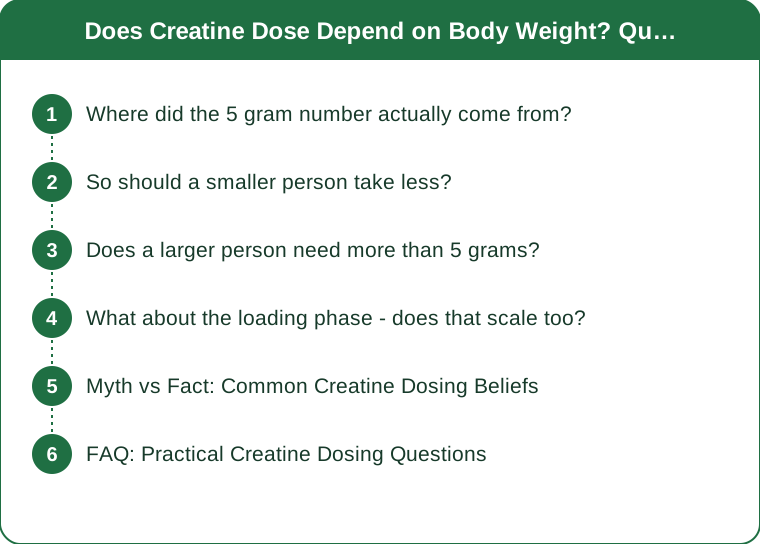
Where did the 5 gram number actually come from?
From maintenance-phase research in the 1990s, most of it conducted on male subjects averaging around 70 to 80 kilograms.
The original studies established that after saturating muscle creatine stores, roughly 2 to 3 grams per day replaces what is lost to normal degradation. Creatine converts to creatinine at a rate of about 1.6 to 2 percent of the total muscle pool per day, and a 70kg person carries roughly 120 to 140 grams of creatine in muscle.
So the actual replacement requirement is around 2 grams. The 5 gram recommendation includes a generous margin for incomplete absorption, variable diet, and the fact that it is an easy number to scoop.
Expressed per kilogram, common protocols land near 0.03 g/kg for maintenance. That is where the body weight scaling comes from - not from a separate line of research, but from converting the original number back into the units it was derived in.
This matters less than the internet suggests. Creatine has a wide effective range and no meaningful downside to modest excess, since unabsorbed creatine is simply excreted.
So should a smaller person take less?
They can, and there is a practical reason to consider it, but it is not required.
A 50 to 58 kilogram person taking 5 grams daily is taking roughly 0.09 to 0.10 g/kg, which is around three times the calculated maintenance requirement. Nothing bad happens - the excess is excreted - but two things are more likely at the higher relative dose.
First, gastrointestinal discomfort. GI side effects from creatine are dose-dependent and largely a function of how much undissolved powder hits the gut at once. Smaller people taking the same absolute dose are more likely to notice it.
Second, cost and taste. Neither is a health matter, but if 3 grams does the same job, the tub lasts 40 percent longer.
The reason many practitioners still recommend 5 grams to everyone is that muscle saturation is what matters, and saturation is easier to guarantee with a margin. Vegetarians in particular start from lower baseline stores - typically 20 to 30 percent below omnivores - and benefit from the higher end.
A reasonable rule: 3 grams if you are under about 60kg and tolerate it fine, 5 grams otherwise, and 5 grams regardless if you eat little or no meat.
Does a larger person need more than 5 grams?
Possibly slightly, though the evidence for going much above 5 is thin.
At 0.03 g/kg, a 100 kilogram person calculates to 3 grams, which seems to contradict the whole scaling idea. The reason is that creatine storage tracks lean mass, not total body weight. A 100kg person with substantial muscle mass carries a larger creatine pool and loses more per day; a 100kg person with the same lean mass as a 70kg person does not.
So the honest version is that the scaling variable is fat-free mass, and most people do not know theirs precisely.
Practically: someone with high muscle mass, training hard, may benefit from 5 to 8 grams daily. Above that, absorption and retention plateau - the muscle transporter system is saturable, and additional intake mostly raises plasma creatine and urinary excretion rather than muscle content.
There is no established benefit to routine doses above 10 grams for performance purposes. Some clinical and neurological research uses much higher doses, but that is a different question with different oversight, and it should not be extrapolated to gym use.

What about the loading phase - does that scale too?
It does, and this is where body weight scaling was always explicit in the research.
The classic loading protocol is 0.3 grams per kilogram per day for 5 to 7 days, split into four doses. For a 60kg person that is 18 grams daily in four 4.5 gram servings. For an 85kg person it is roughly 25 grams in four servings of about 6 grams.
Notice that the loading protocol was always written per kilogram while the maintenance dose got flattened to a single number. That asymmetry is the source of most of the confusion.
Loading is optional. Taking 3 to 5 grams daily without loading reaches the same saturation in roughly three to four weeks instead of one. The end point is identical.
The main reason to load is if you want the effect quickly for a specific reason. The main reason not to is that loading is where nearly all the GI complaints come from, and splitting into four daily doses is a genuine adherence problem for most people.
If you do load, splitting into four doses and taking each with food and a full glass of water reduces discomfort substantially.
Myth vs Fact: Common Creatine Dosing Beliefs
Myth: Women need a much smaller dose than men because they respond differently.
Fact: The dose difference is body size, not sex. Studies on women show comparable increases in muscle creatine content with equivalent per-kilogram doses. Some research suggests women may start with slightly higher baseline intramuscular creatine, but the practical dosing implication is small.
Myth: You need to cycle off creatine periodically.
Fact: There is no evidence supporting cycling. Muscle stores simply drop back toward baseline over about four to six weeks when you stop, and natural production resumes normally. Cycling means spending part of every cycle unsaturated for no benefit.
Myth: Taking more speeds up results.
Fact: Saturation is a ceiling. Once muscle stores are full, additional creatine is excreted. The only thing more gets you faster is arrival at that ceiling, and only during the loading week.
Myth: You must take it immediately post-workout.
Fact: Timing effects are small and inconsistent in the literature. Total daily intake and consistency dominate. Taking it at whatever time you will actually remember is the highest-value strategy.
FAQ: Practical Creatine Dosing Questions
Do I need to adjust my dose if I lose weight?
Not meaningfully. If you lose 5 to 10 kilograms, your calculated maintenance requirement changes by a few tenths of a gram. Well within the margin already built into a 3 to 5 gram dose.
Should I take more on training days?
No. Muscle creatine content changes over weeks, not hours, so daily variation does nothing. A steady daily dose including rest days is the whole protocol.
Does it matter if I miss a day?
Barely. Losing about 2 percent of your pool per day means a missed day costs almost nothing. Missing two weeks would meaningfully reduce saturation. Consistency over months matters; perfection over days does not.
This is general information, not medical advice. If you have kidney disease or take medication affecting kidney function, discuss creatine with your doctor before starting.
TL;DR:
- The 5 gram standard comes from research on roughly 70kg men and equals about 0.03 g/kg for maintenance.
- Under about 60kg, 3 grams is sufficient and reduces the chance of GI discomfort; 5 grams is a safe default with margin.
- Scaling tracks lean mass rather than total weight, and benefits plateau above roughly 5 to 8 grams.
- Loading was always body-weight based at 0.3 g/kg for 5 to 7 days, and it is entirely optional - daily dosing reaches the same saturation in three to four weeks.
- Cycling is unnecessary, timing effects are small, and total consistency is what determines outcome.
If you have been agonizing over whether your scoop is exactly right, the honest answer is that anywhere from 3 to 5 grams taken daily gets you to the same place. This is general information, not medical advice.
Keep Reading
This article is for general informational purposes only and is not medical advice. Always consult a qualified health professional for guidance specific to you.