Is Creatine Safe During Pregnancy? What the Current Evidence Actually Says
Quick Answer: Current research on creatine supplementation specifically during human pregnancy is limited, and most medical guidance recommends avoiding new creatine supplementation during pregnancy until more robust safety data exists, despite creatine’s strong safety record in non-pregnant adult populations — always discuss with your doctor before continuing or starting creatine while pregnant.
Creatine has one of the best-studied safety profiles of any common supplement for general adult use — but “well-studied in general adults” and “well-studied in pregnancy” are two very different evidence bases.

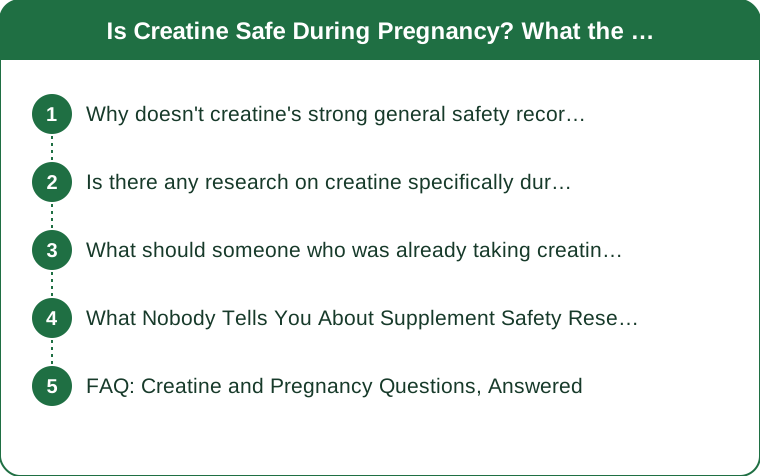
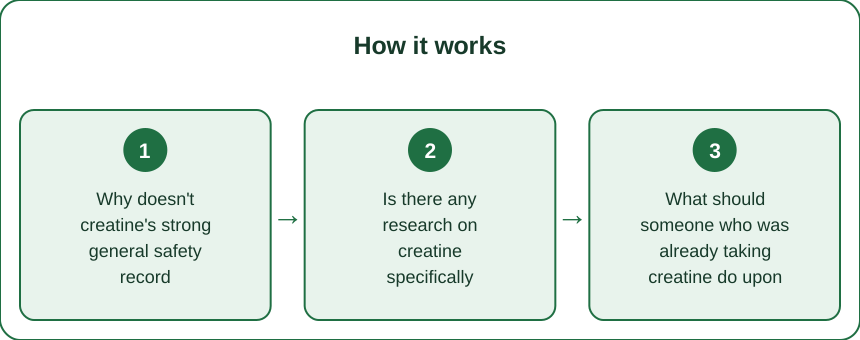
Why doesn’t creatine’s strong general safety record automatically apply to pregnancy?
Pregnancy involves significant physiological changes (blood volume, kidney function, and fetal development) that aren’t present in the general adult populations where most creatine research has been conducted. Supplement safety research in non-pregnant adults doesn’t automatically extend to pregnant populations, since pregnancy-specific studies are needed to confirm safety for both parent and developing fetus.
Is there any research on creatine specifically during pregnancy?
There is a small but growing body of research exploring creatine’s role in fetal development and potential protective effects during birth complications, some of it quite promising from a research perspective — but this is different from established, robust safety guidance for general supplemental use during pregnancy, and shouldn’t be interpreted as a green light for supplementation without medical guidance.

What should someone who was already taking creatine do upon becoming pregnant?
This should be discussed directly with your OB or midwife rather than decided independently — some providers may advise stopping, others may have a different perspective based on your individual health situation and the current state of research, but this is a personal-medical decision, not a general one.
What Nobody Tells You About Supplement Safety Research Gaps
Here’s a pattern worth understanding broadly, not just for creatine: many supplements with excellent general-adult safety profiles simply haven’t been adequately studied in pregnant populations, for ethical and practical research reasons — this is an evidence gap, not necessarily proof of danger. The appropriate response to this kind of gap is caution and medical consultation, not assuming either “probably fine” or “probably dangerous” without guidance, since neither assumption is well-supported by current evidence.
FAQ: Creatine and Pregnancy Questions, Answered
Does creatine intake through food (like meat and fish) need to be limited during pregnancy too?
No — dietary creatine from food sources is a normal part of many pregnancy-safe diets and isn’t the concern; the caution specifically applies to concentrated supplemental creatine, which delivers doses far beyond typical dietary intake.
Is creatine safe during breastfeeding, if not during pregnancy?
This also should be discussed with your doctor specifically, as the evidence gaps and considerations for breastfeeding aren’t identical to pregnancy, though caution is generally still advised pending more research.
Should this same caution apply to other common sports supplements during pregnancy?
Many sports supplements (pre-workout formulas, certain amino acid blends) carry similar evidence gaps for pregnancy specifically — reviewing your full supplement list with your OB during pregnancy is a reasonable, thorough approach. This is general information, not medical advice.
TL;DR:
- Creatine’s strong safety record in general adults doesn’t automatically extend to pregnancy
- Research on creatine specifically during human pregnancy remains limited
- Most guidance recommends caution and avoiding new supplementation without medical guidance
- An evidence gap means uncertainty, not proof of danger — medical consultation is the right response either way
Always discuss creatine and any other supplements with your OB before continuing or starting them during pregnancy — this is general information, not medical advice.
Keep Reading
This article is for general informational purposes only and is not medical advice. Always consult a qualified health professional for guidance specific to you.