Creatine and Menopause: Every Question Answered
Quick Answer: Creatine supplementation during and after menopause may help offset some of the muscle mass and strength decline associated with dropping estrogen levels, when combined with resistance training — research specific to this population is smaller but increasingly supportive.
Most creatine content is written for young, male gym-goers, which leaves genuine questions unanswered for women navigating menopause-related changes in muscle and bone. Here’s a direct Q&A.

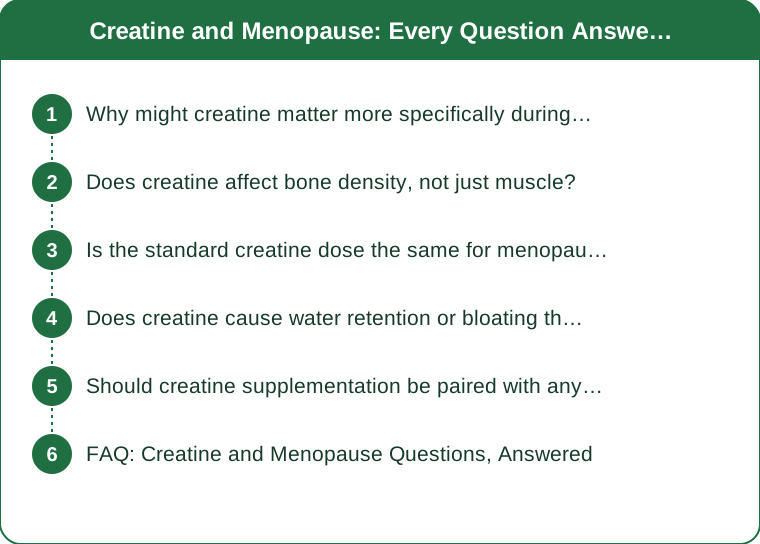
Why might creatine matter more specifically during menopause?
Declining estrogen during menopause is associated with accelerated loss of muscle mass and bone density, and creatine combined with resistance training has research support for helping offset some of this muscle loss — a benefit that’s particularly relevant during a life stage when the body’s natural muscle-preserving mechanisms are working less effectively.
Does creatine affect bone density, not just muscle?
Some research suggests creatine combined with resistance training may support bone density outcomes in postmenopausal women specifically, though this research base is smaller and less definitive than the muscle-strength findings — it’s a promising area rather than a settled one.
Is the standard creatine dose the same for menopausal women as for younger adults?
Generally yes — the commonly studied maintenance dose (around 3-5 grams daily) is the same across most adult populations studied, without strong evidence that menopausal status requires a different dosing approach.

Does creatine cause water retention or bloating that’s worse during menopause?
Creatine can cause mild water retention in the initial weeks for some people, a known and generally temporary effect unrelated specifically to menopause — though some women navigating menopause-related bloating already may want to introduce it gradually and monitor how it feels rather than starting at a high loading dose.
Should creatine supplementation be paired with anything specific during menopause?
Resistance training is the key pairing — creatine’s benefit for muscle mass and strength is best supported when combined with a structured strength training program, since creatine supports training adaptation rather than building muscle independently of training stimulus.
FAQ: Creatine and Menopause Questions, Answered
Is creatine safe to start for the first time during menopause?
Creatine is generally considered safe for most healthy adults, but starting any new supplement during menopause is worth a quick check with a doctor, especially with existing kidney conditions or medications.
How long before menopausal women see benefits from creatine plus strength training?
Most supporting research uses study periods of several months to a year of consistent use paired with training — this isn’t a fast-acting supplement, similar to how it works in other populations.
Does creatine interact with hormone replacement therapy?
There’s no well-established interaction between creatine and HRT specifically, but any supplement addition alongside HRT is reasonable to mention to a prescribing doctor.
TL;DR:
- Creatine plus resistance training may help offset menopause-related muscle loss
- Bone density support is a promising but smaller research area
- Standard dosing (3-5g daily) applies without menopause-specific adjustment
- Creatine’s benefit depends on pairing it with actual strength training
This is general information, not medical advice — check with a doctor before starting creatine, especially alongside HRT or existing health conditions.
Keep Reading
This article is for general informational purposes only and is not medical advice. Always consult a qualified health professional for guidance specific to you.