Creatine and Menopause Questions, Answered
Quick Answer: Creatine supplementation appears particularly relevant during menopause because declining estrogen contributes to accelerated muscle and bone density loss, and creatine (combined with resistance training) has growing evidence supporting its role in helping counter that muscle loss specifically — most standard dosing and safety guidance for creatine applies similarly during menopause, without requiring a fundamentally different protocol.
Creatine’s growing research base in women’s health has increasingly focused on menopause specifically, since this life stage brings physiological changes that make creatine’s muscle-preservation benefits particularly relevant.

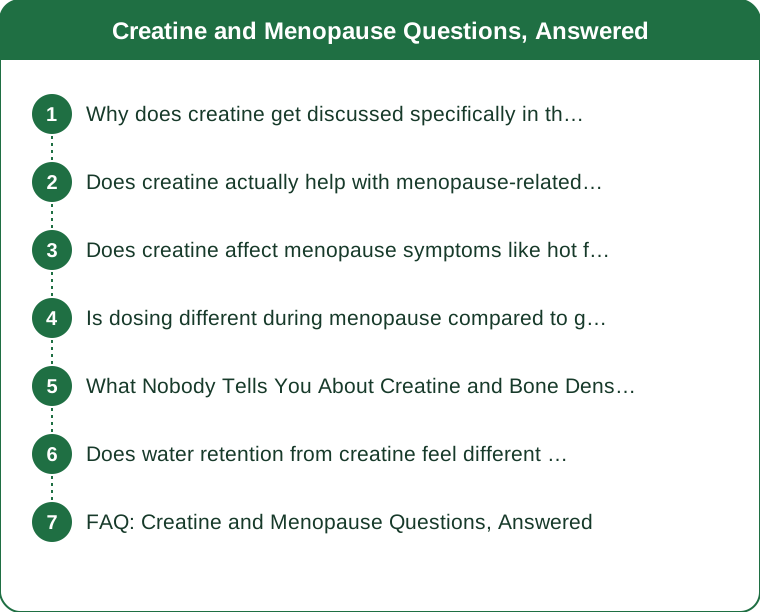
Why does creatine get discussed specifically in the context of menopause?
Declining estrogen during menopause is associated with accelerated loss of muscle mass and bone density, a combination that increases frailty and injury risk over time — creatine, particularly combined with resistance training, has evidence supporting a role in helping preserve muscle mass and strength during this specific physiological transition, making the timing especially relevant.
Does creatine actually help with menopause-related muscle loss specifically?
Research combining creatine supplementation with resistance training in postmenopausal women has shown supportive results for muscle mass and strength preservation, generally more pronounced when creatine is paired with actual resistance training rather than used alone — creatine functions as a support to training-driven muscle preservation, not a standalone substitute for strength training itself.
Does creatine affect menopause symptoms like hot flashes or mood?
There isn’t strong direct evidence that creatine affects vasomotor symptoms (hot flashes) or mood symptoms specifically tied to menopause — its researched benefits center on muscle, strength, and some cognitive function markers, not the hormonal symptom profile of menopause itself.

Is dosing different during menopause compared to general creatine guidance?
No — standard dosing guidance (commonly around 3-5 grams daily) generally applies similarly regardless of menopause status; there’s no established need for a substantially different protocol specifically tied to this life stage.
What Nobody Tells You About Creatine and Bone Density
While creatine’s most established evidence centers on muscle rather than bone directly, some research suggests a possible supportive role for bone health when combined with resistance training, an area of particular relevance given menopause’s association with accelerated bone density loss — this is a promising but still developing area of research, not yet as firmly established as creatine’s muscle-related benefits.
Does water retention from creatine feel different or more noticeable during menopause?
Some women report noticing water retention from creatine more during menopause, though this isn’t strongly established as a menopause-specific effect distinct from creatine’s typical, usually modest and temporary water retention pattern seen across all users when starting supplementation.
FAQ: Creatine and Menopause Questions, Answered
Is creatine safe to start during menopause without other health conditions?
For most healthy adults, creatine has a well-established safety profile; as with any new supplement during a significant health transition, checking with a doctor first is a reasonable precaution, particularly with any existing kidney or health conditions.
Does creatine interact with hormone replacement therapy?
There’s no well-established direct interaction between creatine and hormone replacement therapy, but discussing any new supplement with your prescribing doctor is reasonable given individual health circumstances.
How long before noticing creatine’s muscle-preservation benefits during menopause?
Most research showing meaningful strength and muscle benefits involves consistent use combined with resistance training over 8-12 weeks or longer — it’s not a rapid-effect supplement, and results depend significantly on pairing it with actual training. This is general information, not medical advice.
TL;DR:
- Menopause-related estrogen decline accelerates muscle and bone density loss, making creatine’s relevance clearer
- Creatine’s muscle benefits during menopause are strongest paired with resistance training, not used alone
- Standard dosing (3-5g daily) applies without needing a menopause-specific protocol
- Bone health support is a promising but less established area compared to creatine’s muscle evidence
Creatine isn’t a menopause symptom treatment, but its muscle-preservation role becomes especially relevant during this specific life stage. This is general information, not medical advice.
Keep Reading
This article is for general informational purposes only and is not medical advice. Always consult a qualified health professional for guidance specific to you.